the data value x exists in two data sets: a and b. the mean is equal for both data sets. if the standard…
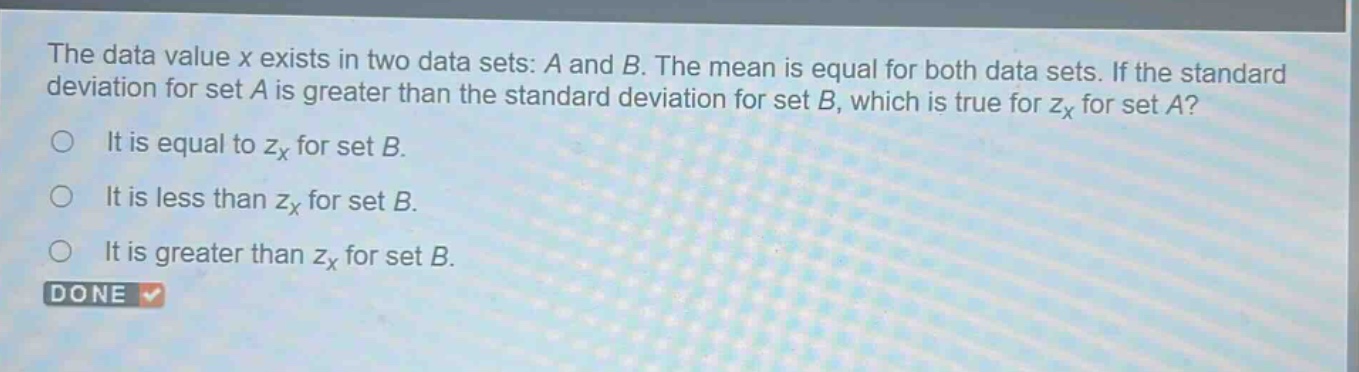
the data value x exists in two data sets: a and b. the mean is equal for both data sets. if the standard deviation for set a is greater than the standard deviation for set b, which is true for $z_x$ for set a?\nit is equal to $z_x$ for set b.\nit is less than $z_x$ for set b.\nit is greater than $z_x$ for set b.
Answer
Explanation:
Step1: Recall z - score formula
The z - score formula is $z=\frac{x - \mu}{\sigma}$, where $x$ is the data - value, $\mu$ is the mean, and $\sigma$ is the standard deviation. Let $\mu_A=\mu_B=\mu$ (since the means of the two data sets are equal). The z - score for data set $A$ is $z_{x,A}=\frac{x - \mu_A}{\sigma_A}=\frac{x - \mu}{\sigma_A}$, and the z - score for data set $B$ is $z_{x,B}=\frac{x - \mu_B}{\sigma_B}=\frac{x - \mu}{\sigma_B}$.
Step2: Compare z - scores based on standard deviation
We know that $\sigma_A>\sigma_B$. Let $k = x-\mu$. Then $z_{x,A}=\frac{k}{\sigma_A}$ and $z_{x,B}=\frac{k}{\sigma_B}$. Since $k$ is the same for both (because $x$ and $\mu$ are the same for both data sets) and $\sigma_A>\sigma_B$, when $k\neq0$, we have $\frac{k}{\sigma_A}<\frac{k}{\sigma_B}$ (if $k>0$, dividing by a larger positive number $\sigma_A$ gives a smaller result; if $k < 0$, dividing by a larger positive number $\sigma_A$ also gives a smaller result in the sense of the magnitude and sign). So $z_{x,A}<z_{x,B}$.
Answer:
It is less than $z_x$ for set $B$.