dating the fossil record\nyou have received nine rock samples from a paleontologist in california. your job…
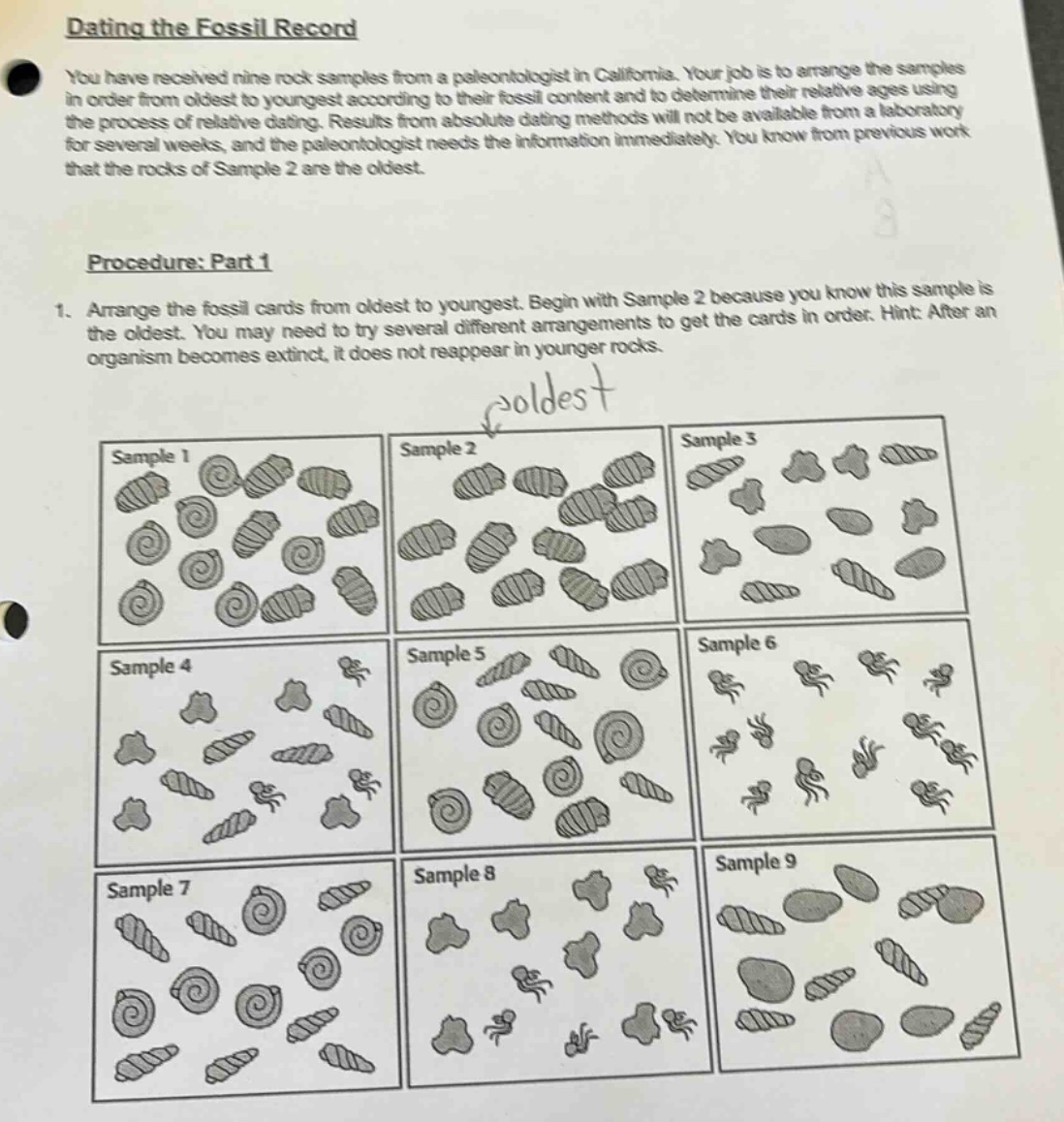
dating the fossil record\nyou have received nine rock samples from a paleontologist in california. your job is to arrange the samples in order from oldest to youngest according to their fossil content and to determine their relative ages using the process of relative dating. results from absolute dating methods will not be available from a laboratory for several weeks, and the paleontologist needs the information immediately. you know from previous work that the rocks of sample 2 are the oldest.\n\nprocedure: part 1\n1. arrange the fossil cards from oldest to youngest. begin with sample 2 because you know this sample is the oldest. you may need to try several different arrangements to get the cards in order. hint: after an organism becomes extinct, it does not reappear in younger rocks.
Answer
Explanation:
Step1: Identify the known - oldest sample
We know Sample 2 is the oldest.
Step2: Analyze fossil content
Look for the presence and absence of fossils. Fossils of organisms that go extinct do not reappear in younger rocks. By observing the fossils in each sample, we can see that Sample 1 has fossils similar to Sample 2 but also some new - appearing ones, so it is younger than Sample 2. Sample 3 has different fossils from Sample 2 and 1, and seems to be a further progression. Sample 4 has some of the fossils from Sample 3 along with new ones. Sample 5 has a mix of fossils from previous samples and some new ones. Sample 6 has new types of fossils not seen in previous ones. Sample 7 has a combination of fossils from earlier samples. Sample 8 has some fossils similar to Sample 4 and 6. Sample 9 has unique fossils compared to others.
Step3: Arrange samples
Based on the above analysis, the order from oldest to youngest is: Sample 2, Sample 1, Sample 3, Sample 7, Sample 5, Sample 4, Sample 8, Sample 6, Sample 9.
Answer:
Sample 2, Sample 1, Sample 3, Sample 7, Sample 5, Sample 4, Sample 8, Sample 6, Sample 9