david wants to complete a hypothesis test with the least amount of probability for error. if he sets the…
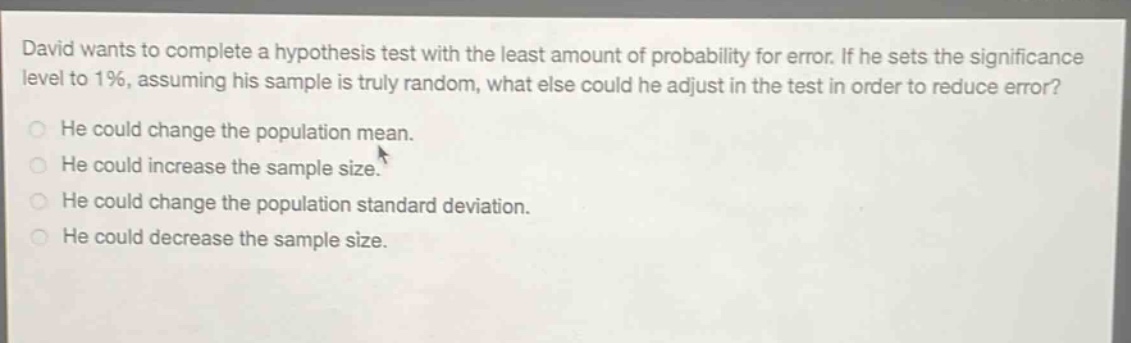
david wants to complete a hypothesis test with the least amount of probability for error. if he sets the significance level to 1%, assuming his sample is truly random, what else could he adjust in the test in order to reduce error?\nhe could change the population mean.\nhe could increase the sample size.\nhe could change the population standard deviation.\nhe could decrease the sample size.
Answer
Answer:
B. He could increase the sample size.
Explanation:
Step1: Understand error in hypothesis test
Error in hypothesis - test can be reduced by certain factors.
Step2: Analyze each option
- Changing population mean is not an adjustable factor in a test.
- Increasing sample size reduces sampling error as $\text{Standard Error}=\frac{\sigma}{\sqrt{n}}$, where $n$ is sample size. Larger $n$ leads to smaller standard error.
- Changing population standard - deviation is not something that can be adjusted in a test.
- Decreasing sample size will increase sampling error. So increasing sample size is the correct way to reduce error.