a deck of 40 cards contains 20 blue and 20 red cards. each color has cards numbered 1 to 20. which events…
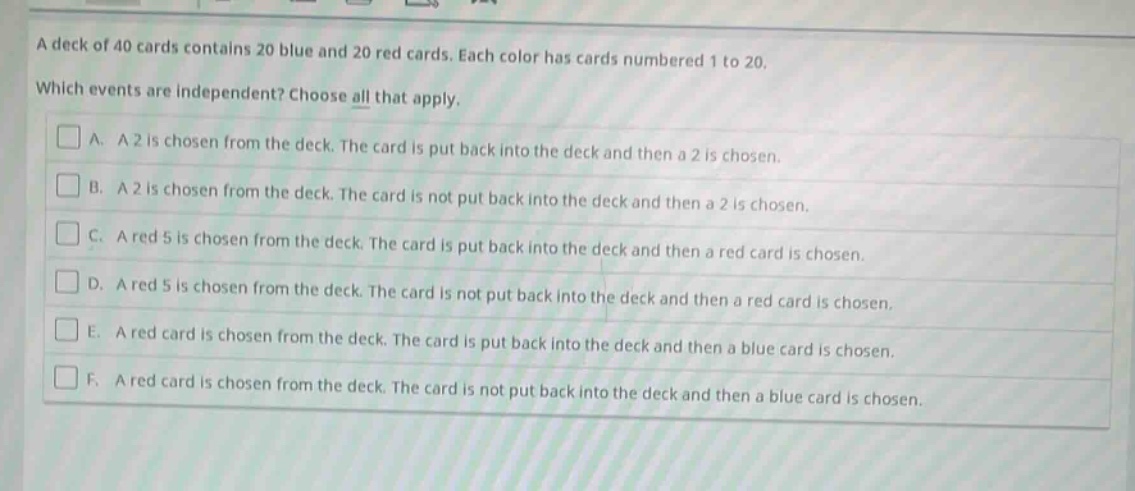
a deck of 40 cards contains 20 blue and 20 red cards. each color has cards numbered 1 to 20. which events are independent? choose all that apply. a. a 2 is chosen from the deck. the card is put back into the deck and then a 2 is chosen. b. a 2 is chosen from the deck. the card is not put back into the deck and then a 2 is chosen. c. a red 5 is chosen from the deck. the card is put back into the deck and then a red card is chosen. d. a red 5 is chosen from the deck. the card is not put back into the deck and then a red card is chosen. e. a red card is chosen from the deck. the card is put back into the deck and then a blue card is chosen. f. a red card is chosen from the deck. the card is not put back into the deck and then a blue card is chosen.
Answer
Explanation:
Step1: Recall independent - event definition
Two events are independent if the occurrence of one event does not affect the probability of the occurrence of the other event. This occurs when sampling is done with replacement.
Step2: Analyze option A
When a 2 is chosen, put back, and then a 2 is chosen again, the probability of choosing a 2 the second time is not affected by the first - choice. The probability of choosing a 2 each time is $\frac{2}{40}=\frac{1}{20}$ (since there are 2 cards numbered 2 in the deck of 40 cards). So, this is an independent event.
Step3: Analyze option B
When the card is not put back after choosing a 2 the first time, the number of cards in the deck and the number of 2 - cards change for the second draw. So, the probability of choosing a 2 the second time is affected by the first draw, and these are dependent events.
Step4: Analyze option C
When a red 5 is chosen and put back, the probability of choosing a red card on the second draw is not affected. The probability of choosing a red 5 first is $\frac{1}{40}$, and the probability of choosing a red card second is $\frac{20}{40}=\frac{1}{2}$. Since the first - card is replaced, these are independent events.
Step5: Analyze option D
When a red 5 is chosen and not put back, the number of red cards in the deck for the second draw is reduced by 1. So, the probability of choosing a red card on the second draw is affected by the first draw, and these are dependent events.
Step6: Analyze option E
When a red card is chosen and put back, the probability of choosing a blue card on the second draw is not affected. The probability of choosing a red card first is $\frac{20}{40}=\frac{1}{2}$, and the probability of choosing a blue card second is $\frac{20}{40}=\frac{1}{2}$. Since the first - card is replaced, these are independent events.
Step7: Analyze option F
When a red card is chosen and not put back, the number of cards in the deck for the second draw is reduced by 1. So, the probability of choosing a blue card on the second draw is affected by the first draw, and these are dependent events.
Answer:
A. A 2 is chosen from the deck. The card is put back into the deck and then a 2 is chosen. C. A red 5 is chosen from the deck. The card is put back into the deck and then a red card is chosen. E. A red card is chosen from the deck. The card is put back into the deck and then a blue card is chosen.