a deck of playing cards has four suits, with thirteen cards in each suit consisting of the numbers 2 through…
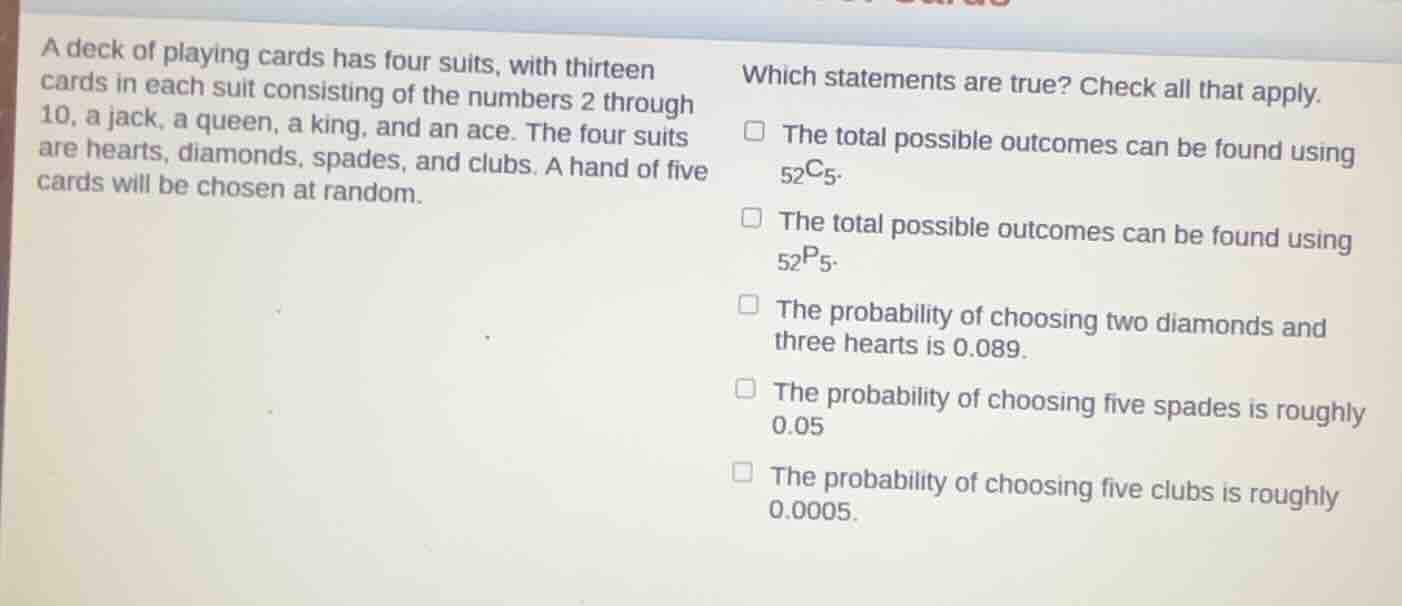
a deck of playing cards has four suits, with thirteen cards in each suit consisting of the numbers 2 through 10, a jack, a queen, a king, and an ace. the four suits are hearts, diamonds, spades, and clubs. a hand of five cards will be chosen at random. which statements are true? check all that apply. the total possible outcomes can be found using $_{52}c_5$. the total possible outcomes can be found using $_{52}p_5$. the probability of choosing two diamonds and three hearts is 0.089. the probability of choosing five spades is roughly 0.05 the probability of choosing five clubs is roughly 0.0005.
Answer
Brief Explanations:
- For ({52}C_5) and ({52}P_5):
- When choosing a hand of five cards, the order of the cards in the hand does not matter. The combination formula ({n}C{r}=\frac{n!}{r!(n - r)!}) is used for unordered selections, and the permutation formula ({n}P{r}=\frac{n!}{(n - r)!}) is used for ordered selections. Since a hand of cards is an unordered set, the total number of possible 5 - card hands from a 52 - card deck is given by ({52}C_5), not ({52}P_5). So the first statement is true and the second is false.
- Probability of two diamonds and three hearts:
- The number of ways to choose 2 diamonds from 13 diamonds is (_{13}C_2=\frac{13!}{2!(13 - 2)!}=\frac{13\times12}{2\times1}=78).
- The number of ways to choose 3 hearts from 13 hearts is (_{13}C_3=\frac{13!}{3!(13 - 3)!}=\frac{13\times12\times11}{3\times2\times1}=286).
- The number of ways to choose 5 cards from 52 cards is (_{52}C_5=\frac{52!}{5!(52 - 5)!}=\frac{52\times51\times50\times49\times48}{5\times4\times3\times2\times1}=2598960).
- The number of favorable outcomes (2 diamonds and 3 hearts) is ({13}C_2\times{13}C_3=78\times286 = 22308).
- The probability (P=\frac{22308}{2598960}\approx0.00858)? Wait, no, wait, I made a mistake. Wait, ({13}C_2=\frac{13!}{2!11!}=\frac{13\times12}{2}=78), ({13}C_3=\frac{13!}{3!10!}=\frac{13\times12\times11}{6}=286), and (78\times286 = 22308). And ({52}C_5 = 2598960). Then (\frac{22308}{2598960}\approx0.00858)? But the statement says 0.089. Wait, maybe I miscalculated. Wait, no, maybe the user made a typo or I messed up. Wait, no, let's recalculate: ({13}C_2 = 78), ({13}C_3=286), (78\times286 = 22308). (22308\div2598960\approx0.00858), which is not 0.089. Wait, maybe I made a mistake in the combination. Wait, no, maybe the problem is about two diamonds and three hearts, but maybe I should consider that the total number of ways to choose 2 diamonds and 3 hearts is ({13}C_2\times_{13}C_3), and the total number of 5 - card hands is ({52}C_5). Wait, maybe the correct calculation is: ({13}C_2=\frac{13\times12}{2}=78), ({13}C_3=\frac{13\times12\times11}{6}=286), (78\times286 = 22308), (22308\div2598960\approx0.00858), so this statement is false? Wait, maybe I made a mistake. Wait, no, let's check again. Wait, the formula for probability is (\frac{\text{number of favorable outcomes}}{\text{total number of possible outcomes}}). The number of favorable outcomes for 2 diamonds and 3 hearts is ({13}C_2\times_{13}C_3), and total outcomes is ({52}C_5). So ({13}C_2 = 78), ({13}C_3 = 286), product is 22308. ({52}C_5=2598960). (22308\div2598960\approx0.00858), so the third statement is false.
- Probability of five spades:
- The number of ways to choose 5 spades from 13 spades is (_{13}C_5=\frac{13!}{5!(13 - 5)!}=\frac{13\times12\times11\times10\times9}{5\times4\times3\times2\times1}=1287).
- The probability (P=\frac{{13}C_5}{{52}C_5}=\frac{1287}{2598960}\approx0.000495\approx0.0005), not 0.05. So the fourth statement is false.
- Probability of five clubs:
- The number of ways to choose 5 clubs from 13 clubs is (_{13}C_5 = 1287) (same as five spades, since there are 13 clubs).
- The probability (P=\frac{{13}C_5}{{52}C_5}=\frac{1287}{2598960}\approx0.000495\approx0.0005). So the fifth statement is true. Also, the first statement (({52}C_5) for total outcomes) is true. Wait, let's re - evaluate the third statement. Wait, maybe I made a mistake in the third statement. Wait, two diamonds and three hearts: number of diamonds is 13, number of hearts is 13. So ({13}C_2=\frac{13!}{2!11!}=78), ({13}C_3=\frac{13!}{3!10!}=286), (78\times286 = 22308). ({52}C_5 = 2598960). (22308\div2598960\approx0.00858), which is about 0.0086, not 0.089. So the third statement is false. Wait, but maybe the question has a different approach. Wait, maybe the user made a mistake, but according to the calculations:
- Statement 1: True (since combination is for unordered, which is correct for a hand of cards).
- Statement 2: False (permutation is for ordered, not for a hand).
- Statement 3: False (calculated probability is ~0.0086, not 0.089).
- Statement 4: False (calculated probability is ~0.0005, not 0.05).
- Statement 5: True (calculated probability is ~0.0005).
Wait, but let's recalculate the probability of five clubs: ({13}C_5=\frac{13\times12\times11\times10\times9}{5\times4\times3\times2\times1}=1287), ({52}C_5 = 2598960), (1287\div2598960\approx0.000495\approx0.0005), so statement 5 is true. And statement 1 is true. Wait, maybe I made a mistake in the third statement. Let's check again: two diamonds and three hearts. The number of diamonds is 13, hearts is 13. So the number of ways to choose 2 diamonds: (C(13,2)=78), 3 hearts: (C(13,3)=286). The number of favorable is (78\times286 = 22308). Total number of 5 - card hands: (C(52,5)=2598960). (22308\div2598960 = 0.00858\approx0.0086), which is not 0.089. So statement 3 is false.
So the true statements are:
- The total possible outcomes can be found using (_{52}C_5).
- The probability of choosing five clubs is roughly 0.0005.
Answer:
- The total possible outcomes can be found using (_{52}C_5).
- The probability of choosing five clubs is roughly 0.0005.