deepali was given two data sets, one without an outlier and one with an outlier. data without an outlier…
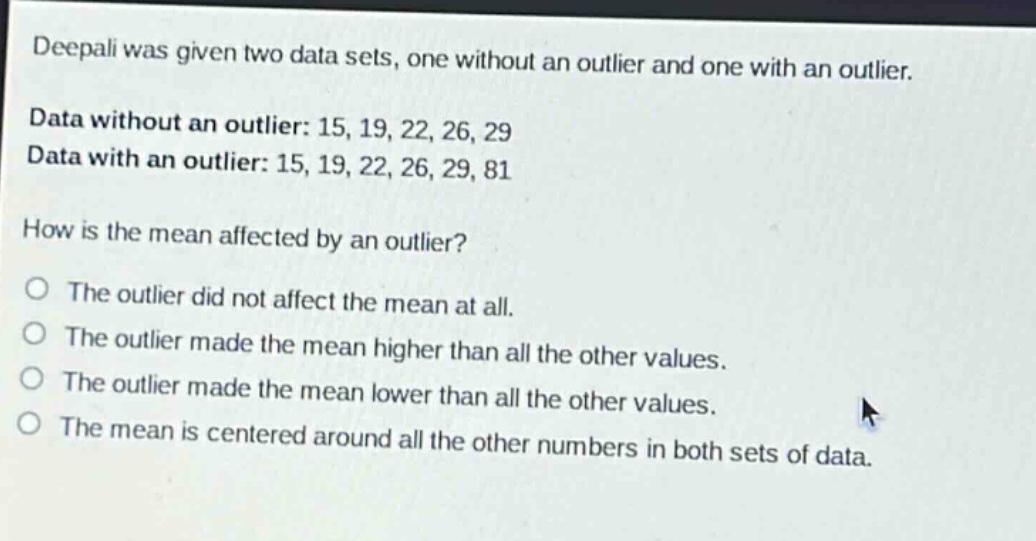
deepali was given two data sets, one without an outlier and one with an outlier. data without an outlier: 15, 19, 22, 26, 29 data with an outlier: 15, 19, 22, 26, 29, 81 how is the mean affected by an outlier? the outlier did not affect the mean at all. the outlier made the mean higher than all the other values. the outlier made the mean lower than all the other values. the mean is centered around all the other numbers in both sets of data.
Answer
Explanation:
Step1: Calculate mean without outlier
The formula for the mean $\bar{x}=\frac{\sum_{i = 1}^{n}x_{i}}{n}$. For data set $15,19,22,26,29$, $n = 5$ and $\sum_{i=1}^{5}x_{i}=15 + 19+22+26+29=111$. So, $\bar{x}_1=\frac{111}{5}=22.2$.
Step2: Calculate mean with outlier
For data set $15,19,22,26,29,81$, $n = 6$ and $\sum_{i = 1}^{6}x_{i}=15+19+22+26+29+81=192$. So, $\bar{x}_2=\frac{192}{6}=32$.
Step3: Analyze the effect of outlier
Since $32>22.2$ and $32$ is higher than most of the non - outlier values, the outlier made the mean higher.
Answer:
The outlier made the mean higher than all the other values.