derek sent a chain letter to his friends, asking them to forward the letter to more friends. the group of…
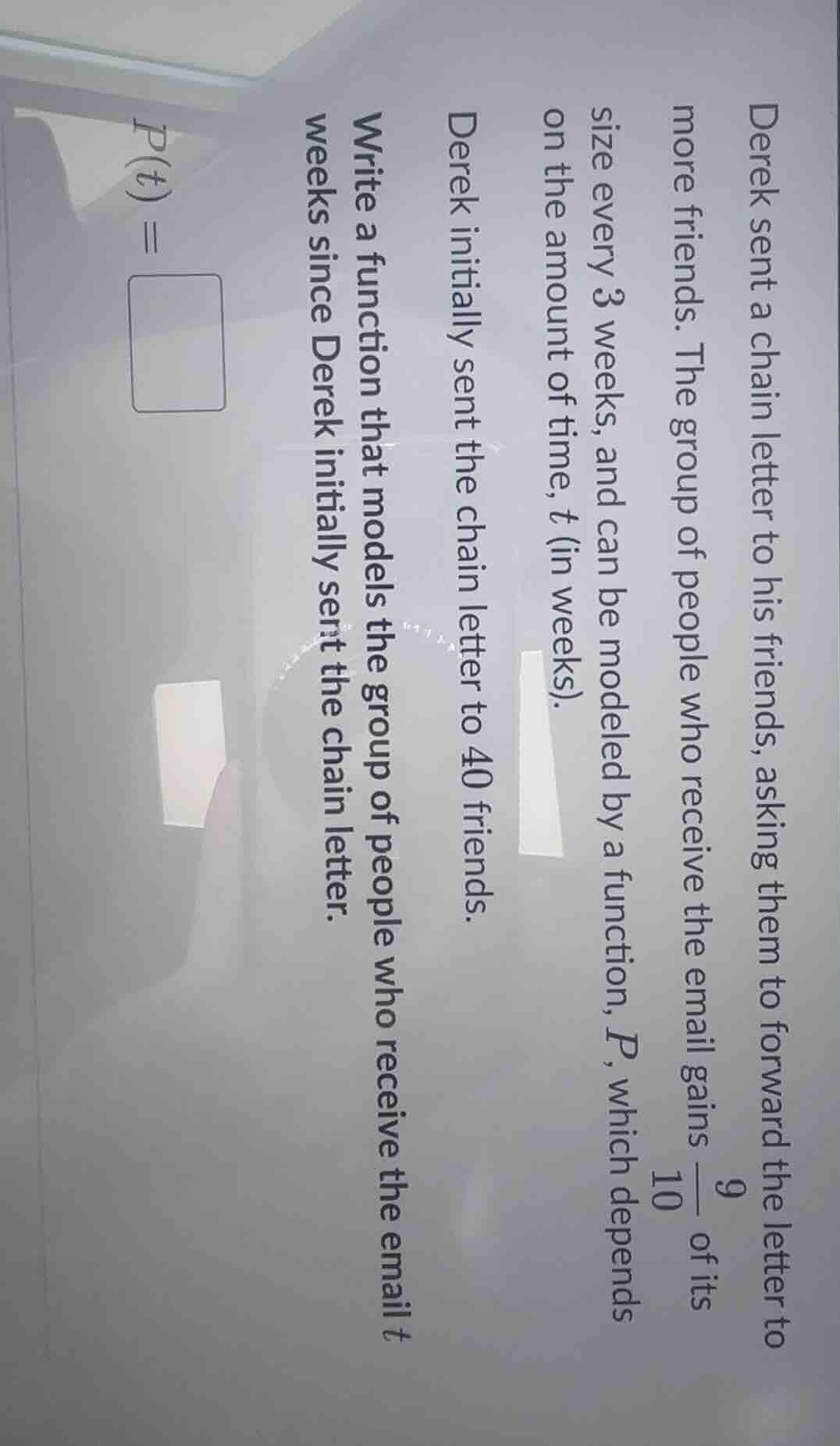
derek sent a chain letter to his friends, asking them to forward the letter to more friends. the group of people who receive the email gains $\frac{9}{10}$ of its size every 3 weeks, and can be modeled by a function, $p$, which depends on the amount of time, $t$ (in weeks).\nderek initially sent the chain letter to 40 friends.\nwrite a function that models the group of people who receive the email $t$ weeks since derek initially sent the chain letter.\n$p(t) = \\square$
Answer
Explanation:
Step1: Identify growth type and parameters
This is exponential growth. Initial population $P_0=40$, growth factor per 3 weeks is $1+\frac{9}{10}=1.9$, time period is 3 weeks.
Step2: Define the exponential function
The general form for exponential growth with periodic growth is $P(t)=P_0 \times (growth\ factor)^{\frac{t}{period}}$. Substitute the values: $P(t)=40 \times \left(1+\frac{9}{10}\right)^{\frac{t}{3}}$ Simplify the growth factor: $1+\frac{9}{10}=\frac{19}{10}=1.9$ So $P(t)=40 \times \left(\frac{19}{10}\right)^{\frac{t}{3}}$ or $P(t)=40(1.9)^{\frac{t}{3}}$
Answer:
$P(t)=40\left(\frac{19}{10}\right)^{\frac{t}{3}}$ or $P(t)=40(1.9)^{\frac{t}{3}}$