describing conditional probabilities\nexplain why $p(a|d)$ and $p(d|a)$ from the table below are not…
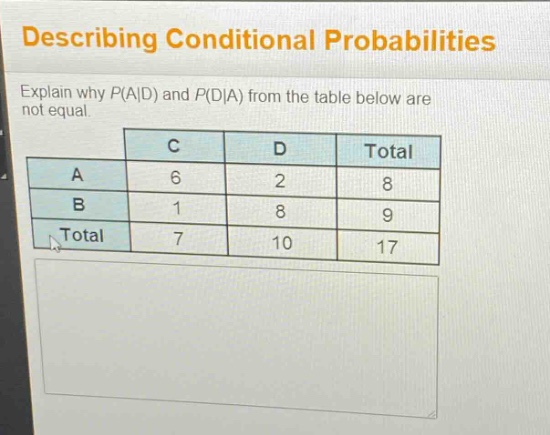
describing conditional probabilities\nexplain why $p(a|d)$ and $p(d|a)$ from the table below are not equal.\n| | c | d | total |\n|----|----|----|----|\n| a | 6 | 2 | 8 |\n| b | 1 | 8 | 9 |\n| total | 7 | 10 | 17 |
Answer
Explanation:
Step1: Recall conditional - probability formula
The formula for conditional probability is $P(X|Y)=\frac{P(X\cap Y)}{P(Y)}$. For $P(A|D)$, we have $P(A|D)=\frac{P(A\cap D)}{P(D)}$. From the table, $P(A\cap D)=\frac{2}{17}$ and $P(D)=\frac{10}{17}$, so $P(A|D)=\frac{\frac{2}{17}}{\frac{10}{17}}=\frac{2}{10} = 0.2$.
Step2: Calculate $P(D|A)$
For $P(D|A)$, using the formula $P(D|A)=\frac{P(D\cap A)}{P(A)}$. From the table, $P(D\cap A)=\frac{2}{17}$ and $P(A)=\frac{8}{17}$, so $P(D|A)=\frac{\frac{2}{17}}{\frac{8}{17}}=\frac{2}{8}=0.25$.
Step3: Compare the two probabilities
Since $P(A|D) = 0.2$ and $P(D|A)=0.25$, $P(A|D)\neq P(D|A)$ because the denominators in the conditional - probability formulas (the probabilities of the conditioning events $D$ and $A$ respectively) are different.
Answer:
$P(A|D)$ and $P(D|A)$ are not equal because in the conditional - probability formula $P(X|Y)=\frac{P(X\cap Y)}{P(Y)}$, the denominators $P(D)$ and $P(A)$ are different. When calculating $P(A|D)=\frac{P(A\cap D)}{P(D)}$ and $P(D|A)=\frac{P(D\cap A)}{P(A)}$, with $P(A\cap D) = P(D\cap A)$, the different values of $P(D)$ and $P(A)$ lead to different results for the two conditional probabilities.