descriptive statistics\ncomparing means without calculation\nfour distributions, labeled (a), (b), (c), and…
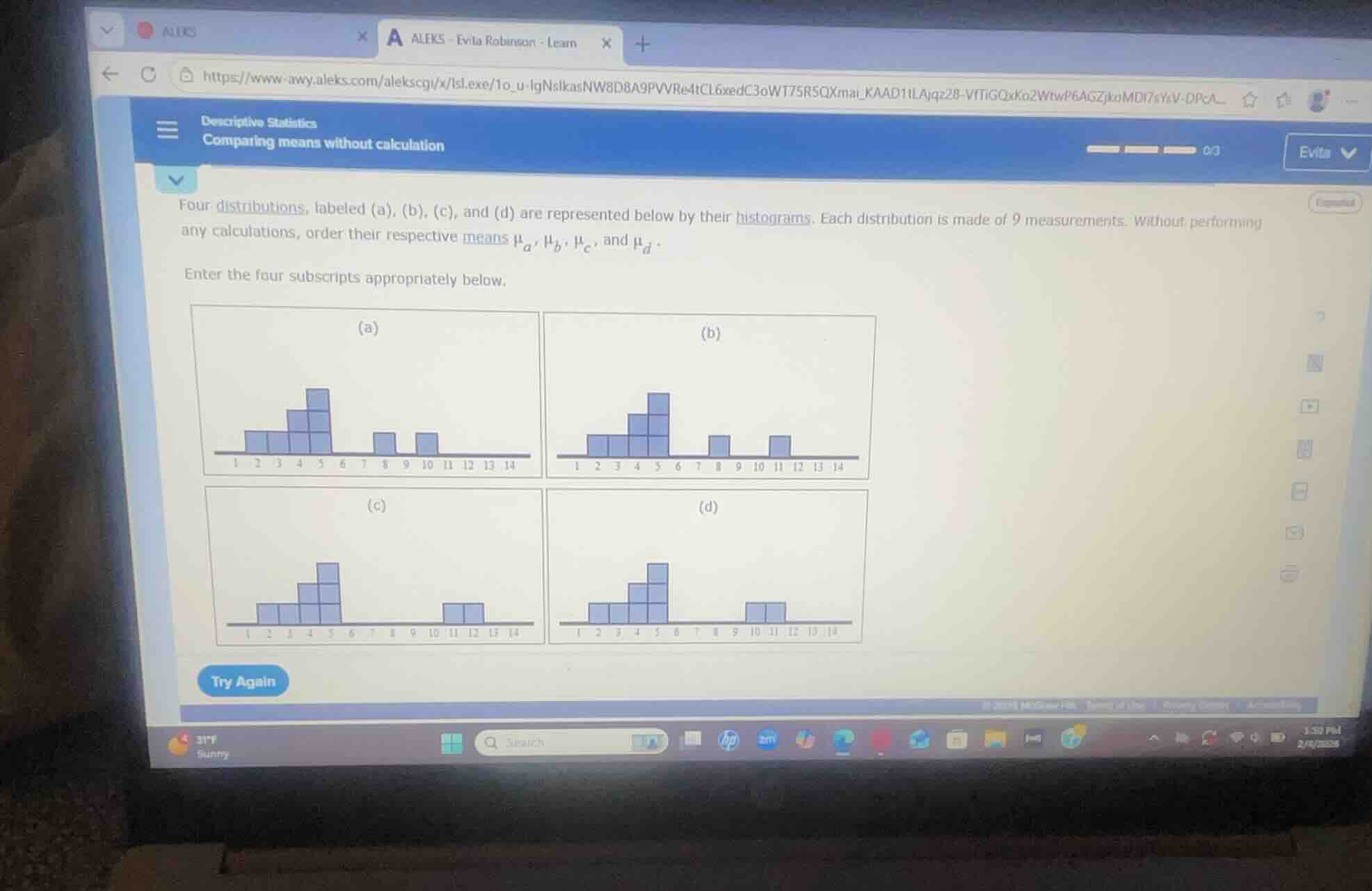
descriptive statistics\ncomparing means without calculation\nfour distributions, labeled (a), (b), (c), and (d) are represented below by their histograms. each distribution is made of 9 measurements. without performing any calculations, order their respective means (mu_a), (mu_b), (mu_c), and (mu_d).\nenter the four subscripts appropriately below.
Answer
Brief Explanations:
- Observe the position of data clusters: The mean of a distribution is pulled toward the direction of its tail or the location of its data points.
- For histogram (b): Its main cluster is leftmost (peaks at 5, tail at 11-12), so it has the smallest mean.
- For histogram (a): Main cluster peaks at 6, tail at 9-10, so its mean is larger than (b) but smaller than the others.
- For histogram (d): Main cluster peaks at 6, tail at 11-12 (farther right than (a)'s tail), so its mean is larger than (a).
- For histogram (c): Main cluster peaks at 6, tail at 12-13 (the farthest right tail), so it has the largest mean.
Answer:
$\mu_b < \mu_a < \mu_d < \mu_c$