determine the upper - tail critical value tα/2 in each of the following circumstances. a. 1 - α = 0.90, n =…
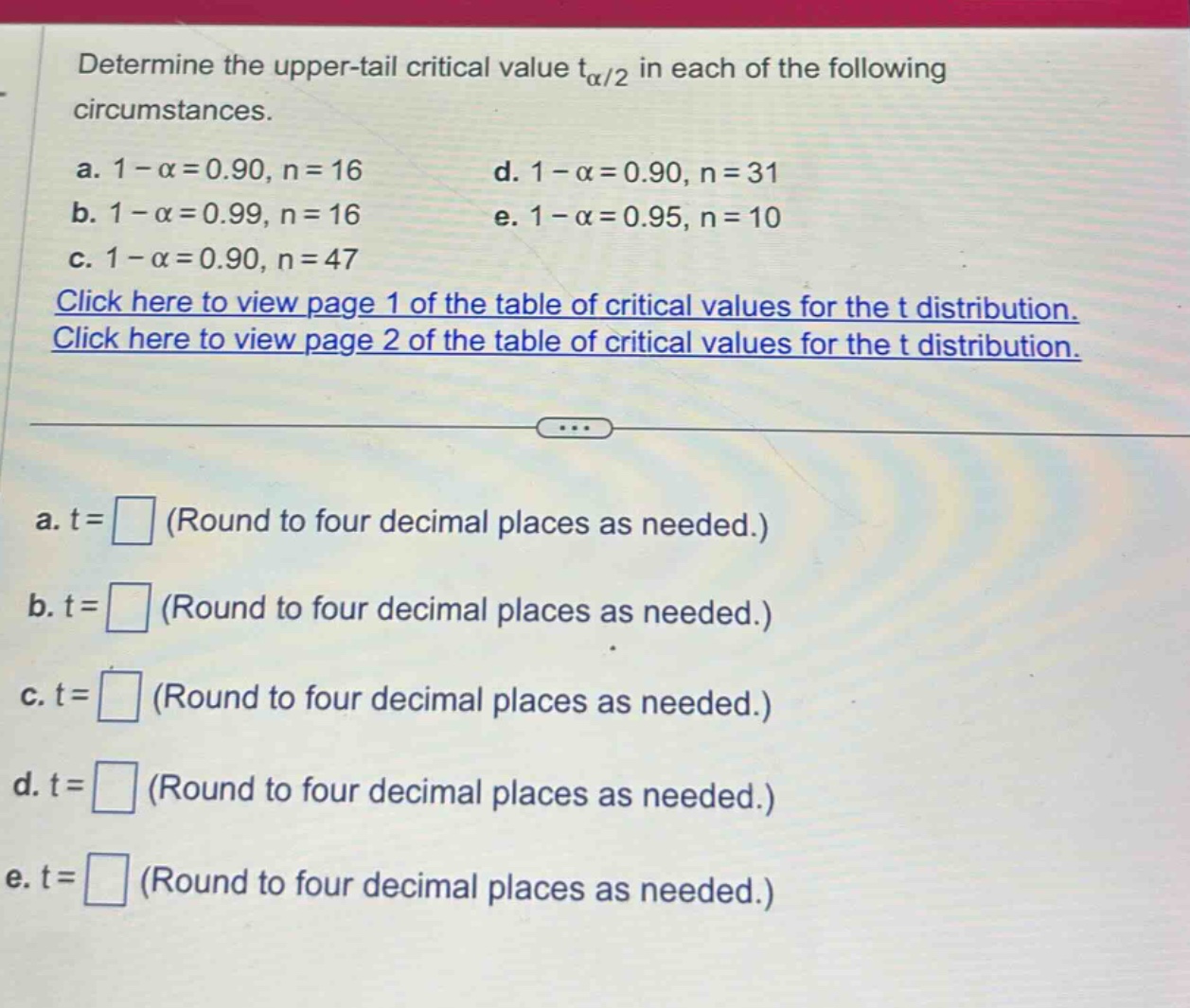
determine the upper - tail critical value tα/2 in each of the following circumstances. a. 1 - α = 0.90, n = 16 b. 1 - α = 0.99, n = 16 c. 1 - α = 0.90, n = 47 d. 1 - α = 0.90, n = 31 e. 1 - α = 0.95, n = 10 click here to view page 1 of the table of critical values for the t distribution. click here to view page 2 of the table of critical values for the t distribution. a. t = (round to four decimal places as needed.) b. t = (round to four decimal places as needed.) c. t = (round to four decimal places as needed.) d. t = (round to four decimal places as needed.) e. t = (round to four decimal places as needed.)
Answer
Explanation:
Step1: Calculate degrees of freedom
The degrees of freedom is calculated as $df=n - 1$.
Step2: Determine $\alpha/2$
Given $1-\alpha$, we find $\alpha$ first and then $\alpha/2$. For example, if $1-\alpha = 0.90$, then $\alpha=0.10$ and $\alpha/2 = 0.05$.
Step3: Look - up in t - distribution table
Use the degrees of freedom and $\alpha/2$ value to find the upper - tail critical value $t_{\alpha/2}$ in the t - distribution table.
a.
- Calculate degrees of freedom: $df=n - 1=16 - 1 = 15$.
- Determine $\alpha/2$: Since $1-\alpha = 0.90$, then $\alpha = 0.10$ and $\alpha/2=0.05$.
- Look - up in t - distribution table: $t_{0.05,15}=1.7531$.
b.
- Calculate degrees of freedom: $df=n - 1=16 - 1 = 15$.
- Determine $\alpha/2$: Since $1-\alpha = 0.99$, then $\alpha = 0.01$ and $\alpha/2 = 0.005$.
- Look - up in t - distribution table: $t_{0.005,15}=2.9467$.
c.
- Calculate degrees of freedom: $df=n - 1=47 - 1 = 46$. When using the t - table, if the exact degrees of freedom is not available, we can use the closest value. For large degrees of freedom, we can also approximate using the standard normal distribution. Using the t - table, we find $t_{0.05,46}\approx1.6794$.
- Determine $\alpha/2$: Since $1-\alpha = 0.90$, then $\alpha = 0.10$ and $\alpha/2=0.05$.
d.
- Calculate degrees of freedom: $df=n - 1=31 - 1 = 30$.
- Determine $\alpha/2$: Since $1-\alpha = 0.90$, then $\alpha = 0.10$ and $\alpha/2=0.05$.
- Look - up in t - distribution table: $t_{0.05,30}=1.6973$.
e.
- Calculate degrees of freedom: $df=n - 1=10 - 1 = 9$.
- Determine $\alpha/2$: Since $1-\alpha = 0.95$, then $\alpha = 0.05$ and $\alpha/2=0.025$.
- Look - up in t - distribution table: $t_{0.025,9}=2.2622$.
Answer:
a. $1.7531$ b. $2.9467$ c. $1.6794$ d. $1.6973$ e. $2.2622$