determine whether the statement is true or false. if it is false, rewrite it as a true statement. a large p…
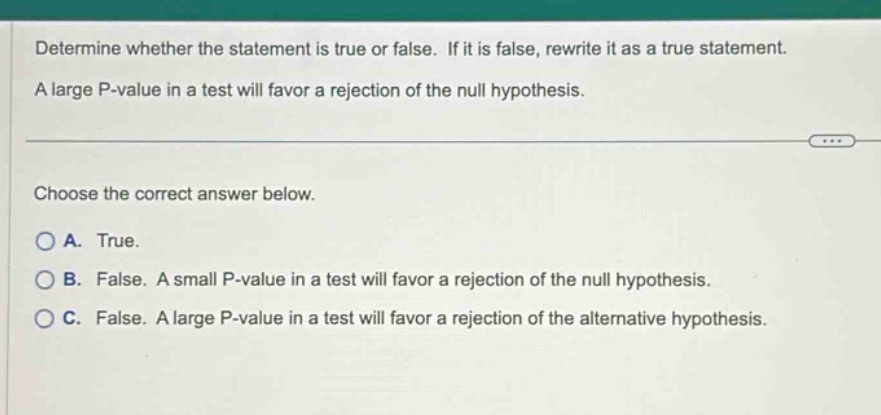
determine whether the statement is true or false. if it is false, rewrite it as a true statement. a large p - value in a test will favor a rejection of the null hypothesis. choose the correct answer below. a. true. b. false. a small p - value in a test will favor a rejection of the null hypothesis. c. false. a large p - value in a test will favor a rejection of the alternative hypothesis.
Answer
Brief Explanations:
The P - value is the probability of obtaining results as extreme as, or more extreme than, the observed results under the null hypothesis. A small P - value (usually less than the significance level, e.g., 0.05) indicates that the observed data is unlikely to have occurred if the null hypothesis is true, thus favoring the rejection of the null hypothesis. A large P - value means that the observed data is likely to occur under the null hypothesis, so we do not reject the null hypothesis.
Answer:
B. False. A small P - value in a test will favor a rejection of the null hypothesis.