determining the regression equation and making predictions\nthe table below shows the population of a town…
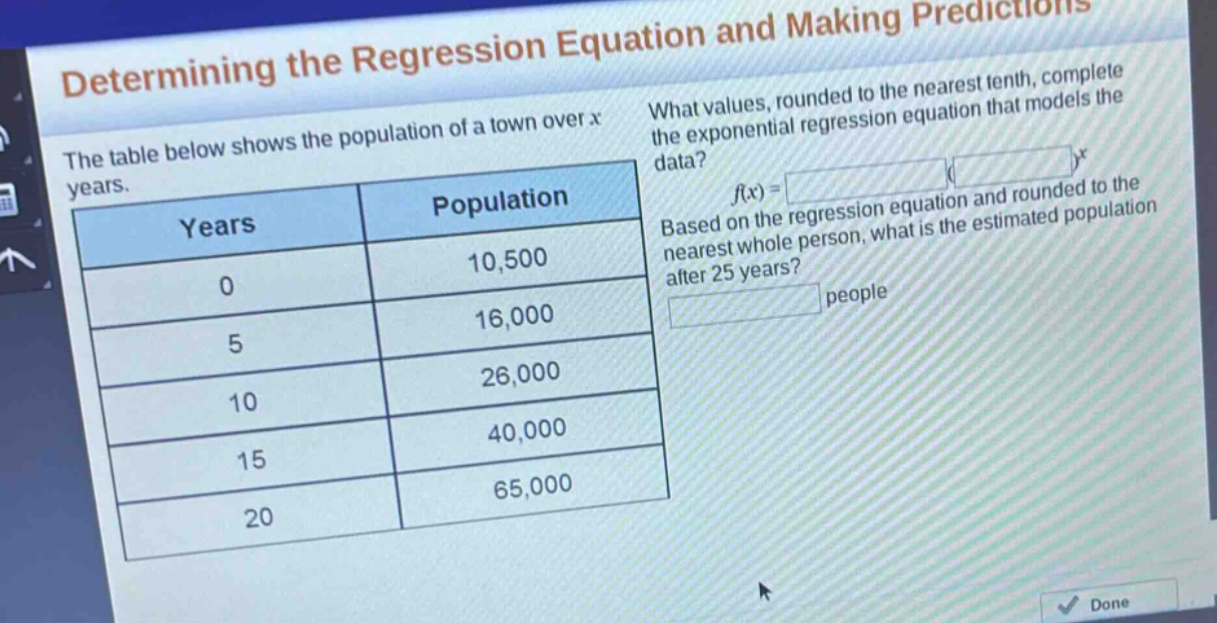
determining the regression equation and making predictions\nthe table below shows the population of a town over x years.\n| years | population |\n| ---- | ---- |\n| 0 | 10,500 |\n| 5 | 16,000 |\n| 10 | 26,000 |\n| 15 | 40,000 |\n| 20 | 65,000 |\nwhat values, rounded to the nearest tenth, complete the exponential regression equation that models the data?\nf(x) = ( )^x\nbased on the regression equation and rounded to the nearest whole person, what is the estimated population after 25 years?\n people
Answer
Explanation:
Step1: Recall exponential regression form
The general form of an exponential regression equation is $f(x)=ab^{x}$. When $x = 0$, $f(0)=a$. From the table, when $x = 0$, the population $f(0)=10500$, so $a = 10500$.
Step2: Find the value of $b$
We use another data - point, say $(x = 5,f(5)=16000)$. Substitute $a = 10500$, $x = 5$ and $f(5)=16000$ into $f(x)=ab^{x}$. We get $16000=10500b^{5}$. Then $b^{5}=\frac{16000}{10500}=\frac{32}{21}$. So $b=\left(\frac{32}{21}\right)^{\frac{1}{5}}\approx1.09$.
Step3: Write the regression equation
The exponential regression equation is $f(x)=10500(1.09)^{x}$.
Step4: Make a prediction
To find the population after 25 years, substitute $x = 25$ into $f(x)=10500(1.09)^{x}$. So $f(25)=10500\times(1.09)^{25}$. Using a calculator, $(1.09)^{25}\approx8.62308066$. Then $f(25)=10500\times8.62308066\approx90542$.
Answer:
$f(x)=10500(1.09)^{x}$; 90542