determining the regression equation and making predictions\nthe table below shows the height of a ball x…
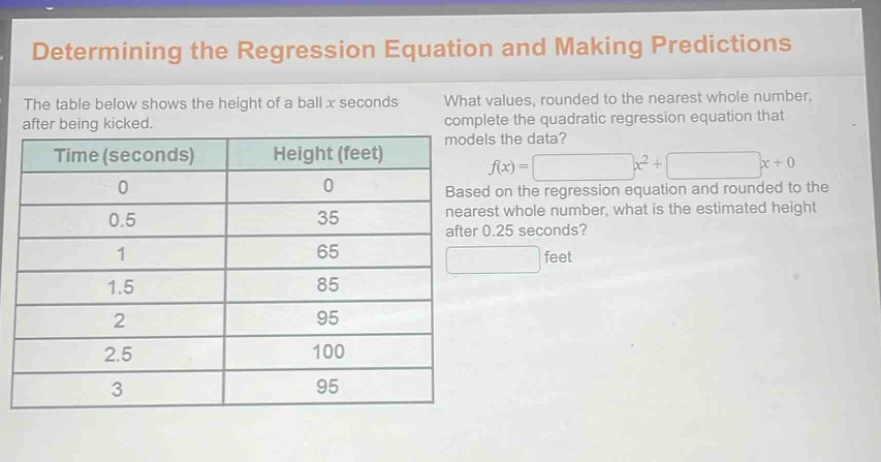
determining the regression equation and making predictions\nthe table below shows the height of a ball x seconds after being kicked.\nwhat values, rounded to the nearest whole number, complete the quadratic regression equation that models the data?\ntime (seconds) height (feet)\n0 0\n0.5 35\n1 65\n1.5 85\n2 95\n2.5 100\n3 95\nf(x)= x²+ x + 0\nbased on the regression equation and rounded to the nearest whole number, what is the estimated height after 0.25 seconds?\n feet
Answer
Explanation:
Step1: Recall quadratic regression formula
The general quadratic regression equation is $y = ax^{2}+bx + c$. Here $c = 0$ and we have data points $(x_i,y_i)$ where $x$ is time and $y$ is height. We can use a system of equations or a statistical - software/calculator. Let's use the least - squares method conceptually. For $n$ data points, we want to minimize the sum of the squared errors $S=\sum_{i = 1}^{n}(y_i-(ax_i^{2}+bx_i + c))^{2}$. Since $c = 0$, we have $S=\sum_{i = 1}^{n}(y_i-(ax_i^{2}+bx_i))^{2}$. We have the following system of equations based on the least - squares principle: $\sum_{i = 1}^{n}y_i=a\sum_{i = 1}^{n}x_i^{2}+b\sum_{i = 1}^{n}x_i$ and $\sum_{i = 1}^{n}x_iy_i=a\sum_{i = 1}^{n}x_i^{3}+b\sum_{i = 1}^{n}x_i^{2}$ For our data: $n = 7$ $\sum_{i = 1}^{7}x_i=0 + 0.5+1+1.5+2+2.5+3=10.5$ $\sum_{i = 1}^{7}x_i^{2}=0^{2}+0.5^{2}+1^{2}+1.5^{2}+2^{2}+2.5^{2}+3^{2}=0 + 0.25+1+2.25+4+6.25+9 = 22.75$ $\sum_{i = 1}^{7}x_i^{3}=0^{3}+0.5^{3}+1^{3}+1.5^{3}+2^{3}+2.5^{3}+3^{3}=0+0.125 + 1+3.375+8+15.625+27=55.125$ $\sum_{i = 1}^{7}y_i=0 + 35+65+85+95+100+95=475$ $\sum_{i = 1}^{7}x_iy_i=0\times0+0.5\times35 + 1\times65+1.5\times85+2\times95+2.5\times100+3\times95$ $=0 + 17.5+65+127.5+190+250+285=935$ The system of equations becomes: $475 = 22.75a+10.5b$ $935 = 55.125a+22.75b$ Multiply the first equation by 2.275: $475\times2.275=22.75a\times2.275+10.5b\times2.275$ $1079.625 = 51.75625a+23.8875b$ Multiply the second equation by 1: $935 = 55.125a+22.75b$ Subtract the first new - equation from the second new - equation: $(55.125a+22.75b)-(51.75625a + 23.8875b)=935 - 1079.625$ $55.125a+22.75b-51.75625a-23.8875b=-144.625$ $3.36875a-1.1375b=-144.625$ From the first original equation $b=\frac{475 - 22.75a}{10.5}$ Substitute $b$ into $3.36875a-1.1375b=-144.625$ $3.36875a-1.1375\times\frac{475 - 22.75a}{10.5}=-144.625$ $3.36875a\times10.5-1.1375\times(475 - 22.75a)=-144.625\times10.5$ $35.371875a-540.25+25.83125a=-1518.5625$ $(35.371875 + 25.83125)a=-1518.5625 + 540.25$ $61.203125a=-978.3125$ $a=-16$ Substitute $a=-16$ into $b=\frac{475 - 22.75a}{10.5}$ $b=\frac{475-22.75\times(-16)}{10.5}=\frac{475 + 364}{10.5}=\frac{839}{10.5}\approx80$ So $f(x)=-16x^{2}+80x$
Step2: Calculate height at $x = 0.25$
Substitute $x = 0.25$ into $f(x)=-16x^{2}+80x$ $f(0.25)=-16\times(0.25)^{2}+80\times0.25$ $=-16\times\frac{1}{16}+20$ $=-1 + 20=19$
Answer:
The quadratic regression equation is $f(x)=-16x^{2}+80x+0$. The estimated height after $0.25$ seconds is $19$ feet.