determining the regression equation\nthe table below shows the approximate height of a ball thrown up in the…
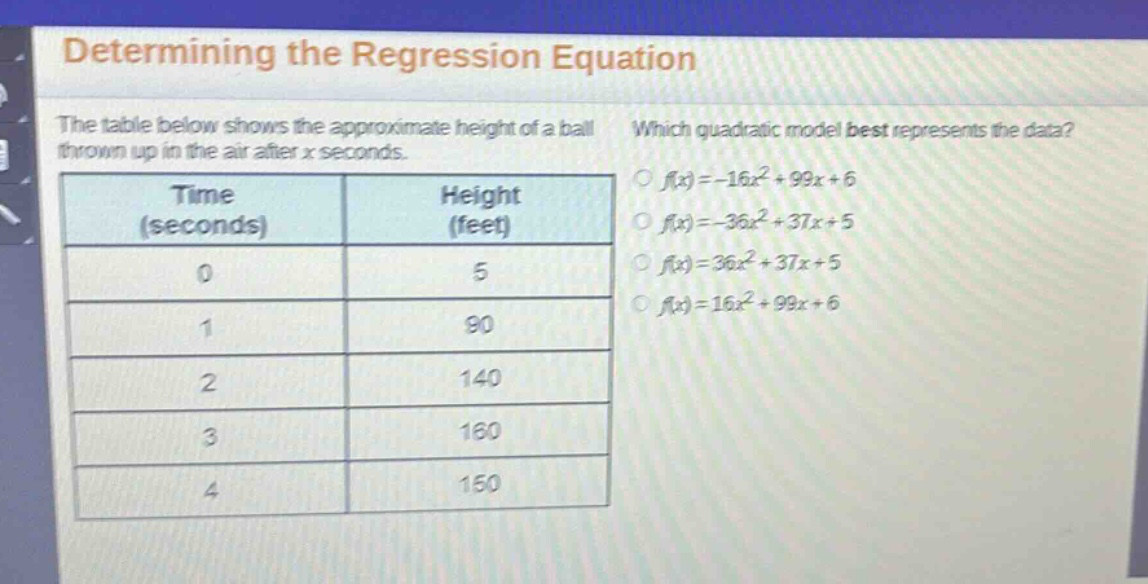
determining the regression equation\nthe table below shows the approximate height of a ball thrown up in the air after x seconds.\nwhich quadratic model best represents the data?\n| time (seconds) | height (feet) |\n| ---- | ---- |\n| 0 | 5 |\n| 1 | 90 |\n| 2 | 140 |\n| 3 | 160 |\n| 4 | 150 |\n○ (f(x)=-16x^{2}+99x + 6)\n○ (f(x)=-36x^{2}+37x + 5)\n○ (f(x)=36x^{2}+37x + 5)\n○ (f(x)=16x^{2}+99x + 6)
Answer
Explanation:
Step1: Substitute x = 0 into each function
When (x = 0), for (f(x)=-16x^{2}+99x + 6), (f(0)=-16\times0^{2}+99\times0 + 6=6); for (f(x)=-36x^{2}+37x + 5), (f(0)=-36\times0^{2}+37\times0+5 = 5); for (f(x)=36x^{2}+37x + 5), (f(0)=36\times0^{2}+37\times0 + 5=5); for (f(x)=16x^{2}+99x + 6), (f(0)=16\times0^{2}+99\times0+6 = 6). The table has (y = 5) when (x = 0), so we can rule out the first and fourth - options.
Step2: Substitute x = 1 into the remaining functions
For (f(x)=-36x^{2}+37x + 5), (f(1)=-36\times1^{2}+37\times1 + 5=-36 + 37+5=6). For (f(x)=36x^{2}+37x + 5), (f(1)=36\times1^{2}+37\times1+5=36 + 37+5=78). The value in the table when (x = 1) is (90), and these don't match well. Let's use another approach. We know the general form of a quadratic regression is (y = ax^{2}+bx + c). Using the point ((0,5)) in (y=ax^{2}+bx + c), we get (5=a\times0^{2}+b\times0 + c), so (c = 5). Using the point ((1,90)) in (y=ax^{2}+bx + 5), we have (90=a\times1^{2}+b\times1+5), so (a + b=85). Using the point ((2,140)) in (y=ax^{2}+bx + 5), we have (140=a\times2^{2}+b\times2+5), so (4a + 2b=135). From (a + b=85), we have (b = 85 - a). Substitute (b = 85 - a) into (4a+2b=135): [ \begin{align*} 4a+2(85 - a)&=135\ 4a + 170-2a&=135\ 2a&=135 - 170\ 2a&=- 35\ a&=-17.5\approx - 16 \end{align*} ] If (a=-16) and (a + b=85), then (b=85+16 = 99)
Answer:
(f(x)=-16x^{2}+99x + 6)