determining relative frequency ratios\nthe following two - way table represents data from a survey asking…
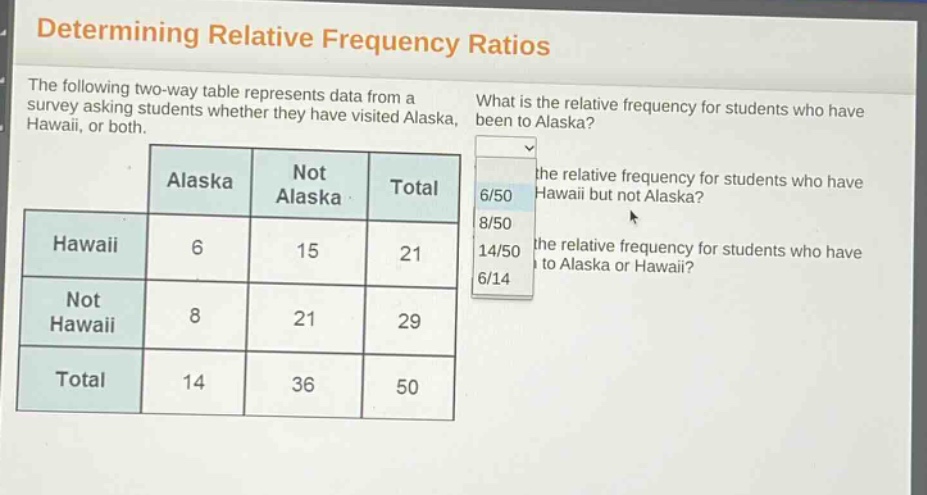
determining relative frequency ratios\nthe following two - way table represents data from a survey asking students whether they have visited alaska, hawaii, or both.\nwhat is the relative frequency for students who have been to alaska?\nwhat is the relative frequency for students who have been to hawaii but not alaska?\nwhat is the relative frequency for students who have been to alaska or hawaii?\n| | alaska | not alaska | total |\n|--|--|--|--|\n| hawaii | 6 | 15 | 21 |\n| not hawaii | 8 | 21 | 29 |\n| total | 14 | 36 | 50 |
Answer
Answer:
- For students who have been to Alaska: $\frac{14}{50}$
- For students who have been to Hawaii but not Alaska: $\frac{15}{50}$
- For students who have been to Alaska or Hawaii: $\frac{21 + 8}{50}=\frac{29}{50}$
Explanation:
Step1: Define relative - frequency formula
Relative frequency = $\frac{\text{Frequency of the event}}{\text{Total frequency}}$
Step2: Find relative frequency for Alaska - visited students
The number of students who have been to Alaska is 14, and total students are 50. So relative frequency = $\frac{14}{50}$
Step3: Find relative frequency for Hawaii - only students
The number of students who have been to Hawaii but not Alaska is 15, and total students are 50. So relative frequency = $\frac{15}{50}$
Step4: Find relative frequency for Alaska or Hawaii students
The number of students who have been to Alaska or Hawaii is $6 + 8+15=29$, and total students are 50. So relative frequency = $\frac{29}{50}$