the diagram below represents an experiment consisting of two independent trials. find p(a and d). p(a and d)…
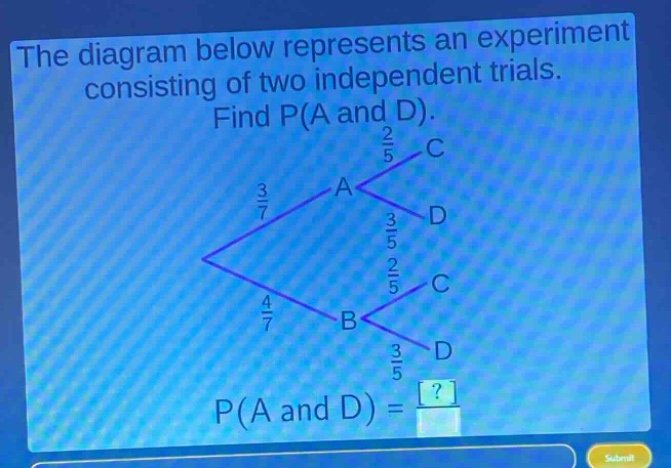
the diagram below represents an experiment consisting of two independent trials. find p(a and d). p(a and d) = ?
Answer
Explanation:
Step1: Identify the probabilities along the path A to D.
The probability of the first event being A is given as $P(A) = \frac{3}{7}$. The probability of the second event being D, given the first event was A, is $P(D|A) = \frac{3}{5}$.
Step2: Calculate the joint probability P(A and D).
For sequential events shown in a tree diagram, the probability of a specific path is the product of the probabilities along that path. $$P(A \text{ and } D) = P(A) \times P(D|A)$$
Step3: Substitute the values and compute the result.
Substitute the identified probabilities into the formula. $$P(A \text{ and } D) = \frac{3}{7} \times \frac{3}{5}$$ $$P(A \text{ and } D) = \frac{3 \times 3}{7 \times 5} = \frac{9}{35}$$
Answer:
$\frac{9}{35}$