the diagram below represents an experiment consisting of two independent trials. find p(b and c). p(b and c)…
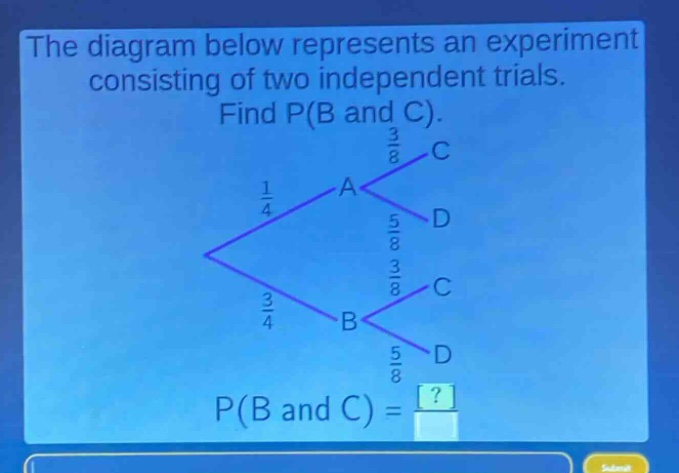
the diagram below represents an experiment consisting of two independent trials. find p(b and c). p(b and c) = ?
Answer
Explanation:
Step1: Identify the probability of event B.
From the diagram, the probability of the first trial resulting in event B is given along the corresponding branch. $$P(B) = \frac{3}{4}$$
Step2: Identify the probability of event C given event B.
From the diagram, the probability of the second trial resulting in event C, given that the first trial resulted in B, is given along the branch from B to C. $$P(C|B) = \frac{3}{8}$$
Step3: Calculate the probability of B and C.
The probability of both event B and event C occurring in sequence is the product of the probabilities along the path B followed by C. $$P(B \text{ and } C) = P(B) \times P(C|B)$$ $$P(B \text{ and } C) = \frac{3}{4} \times \frac{3}{8}$$ $$P(B \text{ and } C) = \frac{3 \times 3}{4 \times 8}$$ $$P(B \text{ and } C) = \frac{9}{32}$$
Answer:
$$\frac{9}{32}$$