the diagram below represents an experiment consisting of two independent trials. find p(b and c). remember…
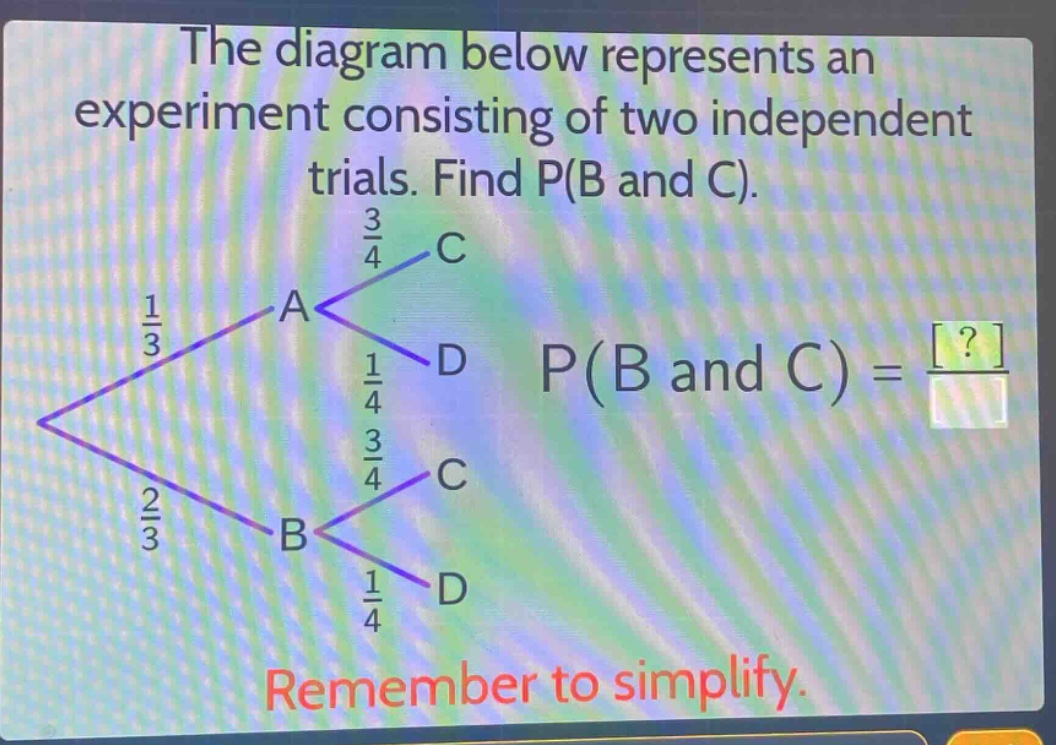
the diagram below represents an experiment consisting of two independent trials. find p(b and c). remember to simplify.
Answer
Explanation:
Step1: Recall probability - multiplication rule for independent events
For two independent events, the probability of both events occurring is the product of their individual probabilities.
Step2: Identify probabilities of B and C
From the tree - diagram, the probability of event B, $P(B)=\frac{2}{3}$, and the probability of event C given B (since they are independent, this is just the probability of C in the second - stage), $P(C)=\frac{3}{4}$.
Step3: Calculate $P(B\ and\ C)$
Using the multiplication rule $P(B\ and\ C)=P(B)\times P(C)$. Substitute $P(B)=\frac{2}{3}$ and $P(C)=\frac{3}{4}$ into the formula: $P(B\ and\ C)=\frac{2}{3}\times\frac{3}{4}$. Simplify the product: $\frac{2\times3}{3\times4}=\frac{6}{12}=\frac{1}{2}$.
Answer:
$\frac{1}{2}$