the diagram represents responses to a survey that include statements p and q. which statement is true? the…
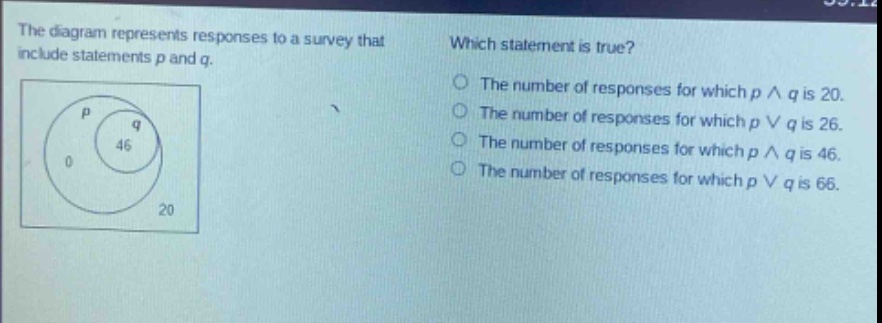
the diagram represents responses to a survey that include statements p and q. which statement is true? the number of responses for which p ∧ q is 20. the number of responses for which p ∨ q is 26. the number of responses for which p ∧ q is 46. the number of responses for which p ∨ q is 66.
Answer
Explanation:
Step1: Definir operadores lógicos
En lógica, $p\land q$ representa la conjunción (y - both) y $p\lor q$ representa la disyunción (o - either). En un diagrama de Venn, $p\land q$ es la intersección de los conjuntos $p$ y $q$, y $p\lor q$ es la unión de los conjuntos $p$ y $q$.
Step2: Identificar valores en el diagrama
En el diagrama de Venn dado, el número dentro de la intersección de $p$ y $q$ es 46, entonces el número de respuestas para las cuales $p\land q$ es 46. La unión $p\lor q$ se calcula sumando los elementos en $p$ que no están en $q$ (0) y los elementos en la intersección (46), es decir $0 + 46=46$.
Answer:
The number of responses for which $p\land q$ is 46.