dice roll you roll a dice 30 times. the outcomes were as follows: number face - up frequency 1 4 2 6 3 3 4 7…
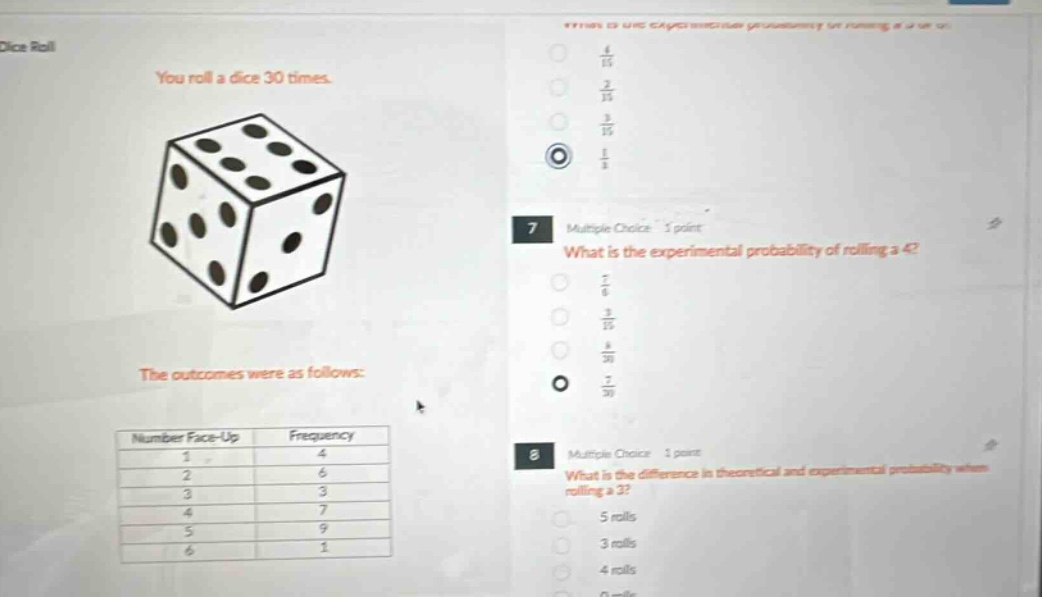
dice roll you roll a dice 30 times. the outcomes were as follows: number face - up frequency 1 4 2 6 3 3 4 7 5 9 6 1 7 multiple choice 1 point what is the experimental probability of rolling a 4? 8 multiple choice 1 point what is the difference in theoretical and experimental probability when rolling a 3?
Answer
Explanation:
Step1: Recall experimental - probability formula
Experimental probability (P(E)=\frac{\text{Number of favorable outcomes}}{\text{Total number of outcomes}})
Step2: Identify values for rolling a 4
The number of times 4 was rolled (favorable outcomes) is 7, and the total number of rolls is 30. So the experimental probability of rolling a 4 is (P(4)=\frac{7}{30})
Step3: Recall theoretical - probability formula for a fair die
For a fair six - sided die, the theoretical probability of rolling any single number is (P=\frac{1}{6})
Step4: Calculate the difference between theoretical and experimental probabilities
The theoretical probability of rolling a 3 is (\frac{1}{6}), and from the table, the number of times 3 was rolled is 3. The experimental probability of rolling a 3 is (\frac{3}{30}=\frac{1}{10}) The difference is (\left|\frac{1}{6}-\frac{1}{10}\right|=\left|\frac{5 - 3}{30}\right|=\frac{2}{30}=\frac{1}{15})
Answer:
- D. (\frac{7}{30})
- C. (\frac{1}{15})