directions: answer the following questions based on the paragraphs.\nearth is made up of mostly rock. high…
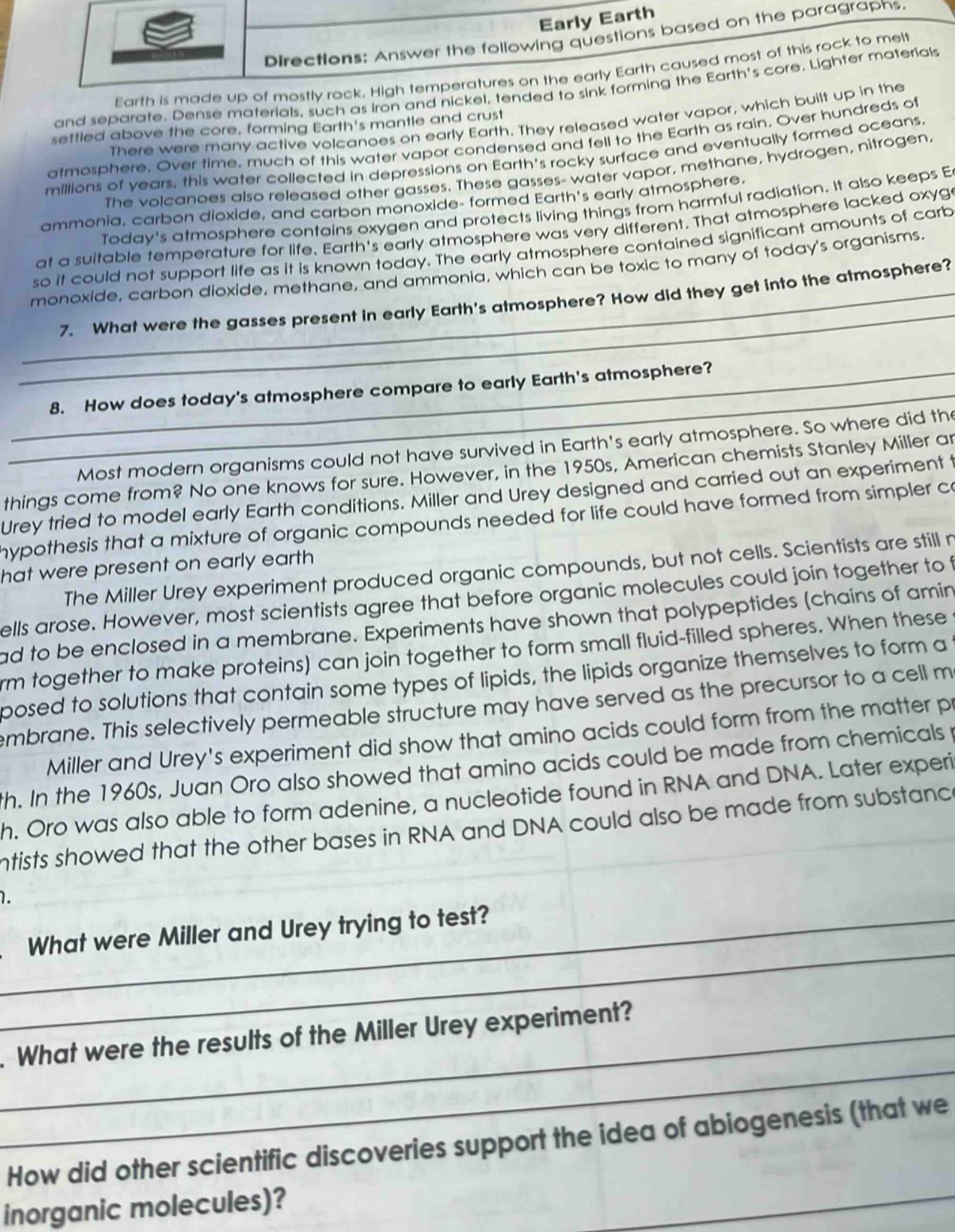
directions: answer the following questions based on the paragraphs.\nearth is made up of mostly rock. high temperatures on the early earth caused most of this rock to melt and separate. dense materials, such as iron and nickel, tended to sink forming the earths core. lighter materials settled above the core, forming earths mantle and crust.\nthere were many active volcanoes on early earth. they released water vapor, which built up in the atmosphere. over time, much of this water vapor condensed and fell to the earth as rain. over hundreds of millions of years, this water collected in depressions on earths rocky surface and eventually formed oceans.\nthe volcanoes also released other gases. these gases - water vapor, methane, hydrogen, ammonia, carbon dioxide, and carbon monoxide - formed earths early atmosphere.\ntodays atmosphere contains oxygen and protects living things from harmful radiation. it also keeps earth at a suitable temperature for life. earths early atmosphere was very different. that early atmosphere lacked oxygen so it could not support life as it is known today. the early atmosphere contained significant amounts of carbon monoxide, carbon dioxide, methane, and ammonia, which can be toxic to many of todays organisms.\n7. what were the gasses present in early earths atmosphere? how did they get into the atmosphere?\n8. how does todays atmosphere compare to early earths atmosphere?\nmost modern organisms could not have survived in earths early atmosphere. so where did the things come from? no one knows for sure. however, in the 1950s, american chemists stanley miller and urey tried to model early earth conditions. miller and urey designed and carried out an experiment to test the hypothesis that a mixture of organic compounds needed for life could have formed from simpler compounds that were present on early earth\nthe miller urey experiment produced organic compounds, but not cells. scientists are still not sure how cells arose. however, most scientists agree that before organic molecules could join together to form cells, they had to be enclosed in a membrane. experiments have shown that polypeptides (chains of amino acids that join together to make proteins) can join together to form small fluid - filled spheres. when these spheres are exposed to solutions that contain some types of lipids, the lipids organize themselves to form a membrane. this selectively permeable structure may have served as the precursor to a cell membrane.\nmiller and ureys experiment did show that amino acids could form from the matter present on early earth. in the 1960s, juan oro also showed that amino acids could be made from chemicals present on early earth. oro was also able to form adenine, a nucleotide found in rna and dna. later experiments by other scientists showed that the other bases in rna and dna could also be made from substances present on early earth.\n9. what were miller and urey trying to test?\n10. what were the results of the miller urey experiment?\n11. how did other scientific discoveries support the idea of abiogenesis (that we can make organic molecules from inorganic molecules)?
Answer
Brief Explanations:
- The gases present in early Earth's atmosphere were water vapor, methane, hydrogen, ammonia, carbon dioxide, and carbon monoxide. They got into the atmosphere from active volcanoes on early Earth.
- Today's atmosphere contains oxygen and protects living things from harmful radiation. Early Earth's atmosphere lacked oxygen and contained significant amounts of carbon monoxide, carbon dioxide, methane, and ammonia which can be toxic to many of today's organisms.
- Miller and Urey were trying to test the hypothesis that a mixture of organic compounds needed for life could have formed from simpler compounds that were present on early Earth.
- The results of the Miller - Urey experiment were that it produced organic compounds, specifically showed that amino acids could be made from chemicals present on early Earth.
- Other scientific discoveries like Juan Oro forming adenine (a nucleotide in RNA and DNA) and showing other bases in RNA and DNA could be made from substances on early Earth support the idea of abiogenesis as they demonstrate that complex organic molecules could form from inorganic molecules.
Answer:
- The gases were water vapor, methane, hydrogen, ammonia, carbon dioxide, carbon monoxide. They came from volcanoes.
- Today's atmosphere has oxygen and radiation - protection; early Earth's atmosphere lacked oxygen and had toxic gases.
- They were testing if organic compounds for life could form from simpler early - Earth compounds.
- It produced organic compounds, showed amino acids could be made.
- Discoveries like forming adenine and other DNA/RNA bases from early - Earth substances support abiogenesis.