directions: complete each problem with work. the test will consist of 20 mc questions and 5 sa problems. 1…
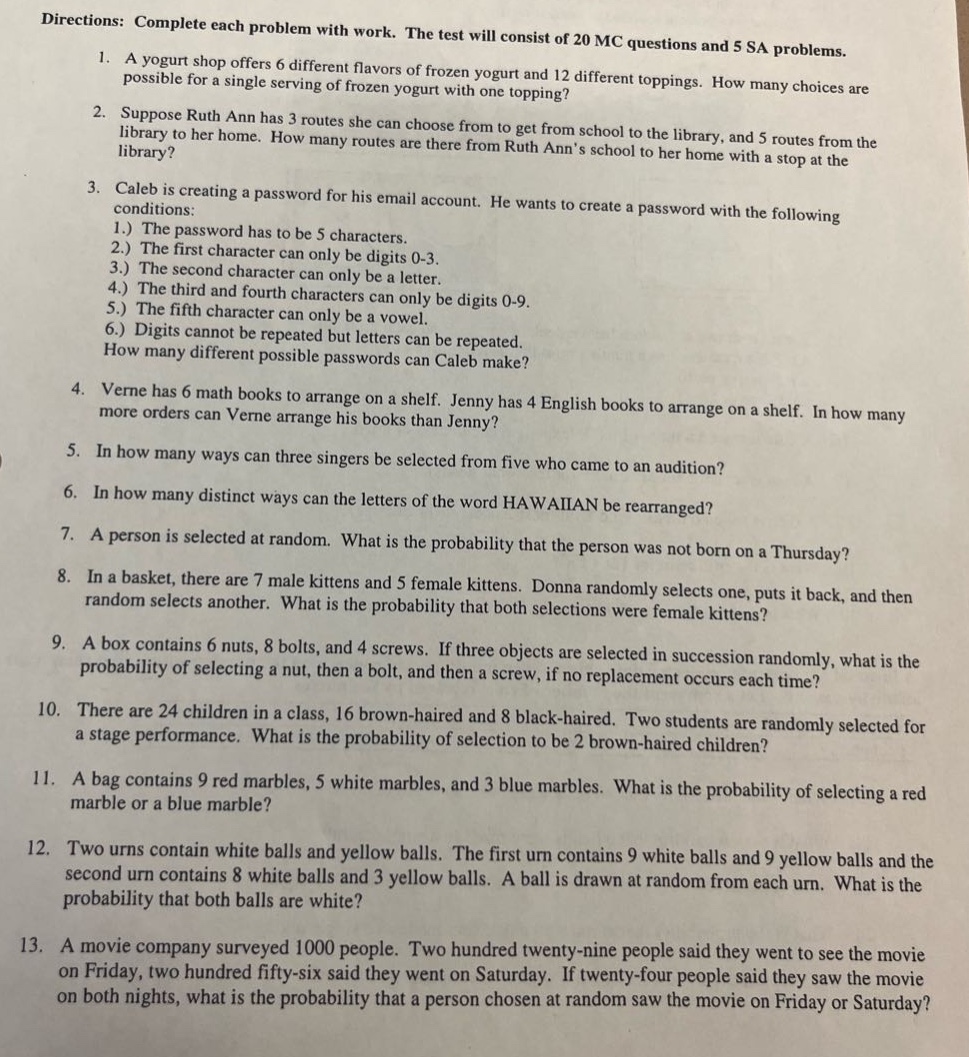
directions: complete each problem with work. the test will consist of 20 mc questions and 5 sa problems. 1. a yogurt shop offers 6 different flavors of frozen yogurt and 12 different toppings. how many choices are possible for a single - serving of frozen yogurt with one topping? 2. suppose ruth ann has 3 routes she can choose from to get from school to the library, and 5 routes from the library to her home. how many routes are there from ruth anns school to her home with a stop at the library? 3. caleb is creating a password for his email account. he wants to create a password with the following conditions: 1.) the password has to be 5 characters. 2.) the first character can only be digits 0 - 3. 3.) the second character can only be a letter. 4.) the third and fourth characters can only be digits 0 - 9. 5.) the fifth character can only be a vowel. 6.) digits cannot be repeated but letters can be repeated. how many different possible passwords can caleb make? 4. verne has 6 math books to arrange on a shelf. jenny has 4 english books to arrange on a shelf. in how many more orders can verne arrange his books than jenny? 5. in how many ways can three singers be selected from five who came to an audition? 6. in how many distinct ways can the letters of the word hawaiian be rearranged? 7. a person is selected at random. what is the probability that the person was not born on a thursday? 8. in a basket, there are 7 male kittens and 5 female kittens. donna randomly selects one, puts it back, and then random selects another. what is the probability that both selections were female kittens? 9. a box contains 6 nuts, 8 bolts, and 4 screws. if three objects are selected in succession randomly, what is the probability of selecting a nut, then a bolt, and then a screw, if no replacement occurs each time? 10. there are 24 children in a class, 16 brown - haired and 8 black - haired. two students are randomly selected for a stage performance. what is the probability of selection to be 2 brown - haired children? 11. a bag contains 9 red marbles, 5 white marbles, and 3 blue marbles. what is the probability of selecting a red marble or a blue marble? 12. two urns contain white balls and yellow balls. the first urn contains 9 white balls and 9 yellow balls and the second urn contains 8 white balls and 3 yellow balls. a ball is drawn at random from each urn. what is the probability that both balls are white? 13. a movie company surveyed 1000 people. two hundred twenty - nine people said they went to see the movie on friday, two hundred fifty - six said they went on saturday. if twenty - four people said they saw the movie on both nights, what is the probability that a person chosen at random saw the movie on friday or saturday?
Answer
1.
Explanation:
Step1: Use multiplication principle
The number of ways to choose a flavor is 6 and the number of ways to choose a topping is 12. By the multiplication - principle, the total number of choices is the product of the number of ways to choose a flavor and the number of ways to choose a topping. $6\times12$
Step2: Calculate the result
$6\times12 = 72$
Answer:
72
2.
Explanation:
Step1: Use multiplication principle
The number of routes from school to library is 3 and the number of routes from library to home is 5. By the multiplication - principle, the total number of routes from school to home with a stop at the library is the product of the two numbers of routes. $3\times5$
Step2: Calculate the result
$3\times5=15$
Answer:
15
3.
Explanation:
Step1: Analyze the number of choices for each character
For the first character (digits 0 - 3), there are 4 choices. For the second character (letters), there are 26 choices. For the third character (digits 0 - 9 excluding the one used for the first character), there are 9 choices. For the fourth character (digits 0 - 9 excluding the two used for the first and third characters), there are 8 choices. For the fifth character (vowels a, e, i, o, u), there are 5 choices.
Step2: Use multiplication principle
The total number of possible passwords is the product of the number of choices for each character. $4\times26\times9\times8\times5$
Step3: Calculate the result
$4\times26\times9\times8\times5=(4\times26)\times(9\times8)\times5 = 104\times72\times5=104\times360 = 37440$
Answer:
37440
4.
Explanation:
Step1: Calculate the number of arrangements for Verne's books
The number of ways to arrange $n$ distinct objects is $n!$. Verne has 6 math books, so the number of arrangements is $6! = 6\times5\times4\times3\times2\times1=720$.
Step2: Calculate the number of arrangements for Jenny's books
Jenny has 4 English books, so the number of arrangements is $4! = 4\times3\times2\times1 = 24$.
Step3: Find the difference
The difference in the number of arrangements is $6!-4!$. $720 - 24=696$
Answer:
696
5.
Explanation:
Step1: Use combination formula
The combination formula is $C(n,r)=\frac{n!}{r!(n - r)!}$, where $n$ is the total number of items and $r$ is the number of items to be selected. Here, $n = 5$ and $r=3$. $C(5,3)=\frac{5!}{3!(5 - 3)!}=\frac{5!}{3!2!}$
Step2: Expand the factorials
$\frac{5\times4\times3!}{3!\times2\times1}$
Step3: Simplify
$\frac{5\times4}{2\times1}=10$
Answer:
10
6.
Explanation:
Step1: Identify the number of letters and repeated letters
The word "HAWAIIAN" has 8 letters. The letter 'A' appears 3 times and the letter 'I' appears 2 times.
Step2: Use the formula for permutations of multi - sets
The number of distinct permutations of a word with $n$ letters, where the letter $a_1$ is repeated $n_1$ times, the letter $a_2$ is repeated $n_2$ times, $\cdots$, the letter $a_k$ is repeated $n_k$ times is $\frac{n!}{n_1!n_2!\cdots n_k!}$. Here, $n = 8$, $n_1=3$ (for 'A') and $n_2 = 2$ (for 'I'). $\frac{8!}{3!2!}=\frac{8\times7\times6\times5\times4\times3!}{3!\times2\times1}$
Step3: Simplify
$\frac{8\times7\times6\times5\times4}{2\times1}=3360$
Answer:
3360
7.
Explanation:
Step1: Determine the total number of days and non - Thursday days
There are 7 days in a week. The number of days that are not Thursday is 6.
Step2: Calculate the probability
The probability $P$ that a person was not born on a Thursday is the number of non - Thursday days divided by the total number of days. $P=\frac{6}{7}$
Answer:
$\frac{6}{7}$
8.
Explanation:
Step1: Calculate the probability of the first selection
The probability of selecting a female kitten on the first draw is $\frac{5}{7 + 5}=\frac{5}{12}$ since there are 5 female kittens and a total of $7+5 = 12$ kittens.
Step2: Calculate the probability of the second selection
Since the kitten is put back, the probability of selecting a female kitten on the second draw is also $\frac{5}{12}$.
Step3: Use the multiplication rule for independent events
The probability that both selections were female kittens is the product of the probabilities of each selection. $\frac{5}{12}\times\frac{5}{12}=\frac{25}{144}$
Answer:
$\frac{25}{144}$
9.
Explanation:
Step1: Calculate the probability of the first selection
There are $6 + 8+4=18$ objects in total. The probability of selecting a nut first is $\frac{6}{18}$.
Step2: Calculate the probability of the second selection
After selecting a nut, there are 17 objects left. The probability of selecting a bolt second is $\frac{8}{17}$.
Step3: Calculate the probability of the third selection
After selecting a nut and a bolt, there are 16 objects left. The probability of selecting a screw third is $\frac{4}{16}$.
Step4: Use the multiplication rule for dependent events
The probability of the sequence is $\frac{6}{18}\times\frac{8}{17}\times\frac{4}{16}=\frac{6\times8\times4}{18\times17\times16}=\frac{192}{4896}=\frac{4}{102}=\frac{2}{51}$
Answer:
$\frac{2}{51}$
10.
Explanation:
Step1: Calculate the probability of the first selection
The probability of selecting a brown - haired child first is $\frac{16}{24}$.
Step2: Calculate the probability of the second selection
After selecting a brown - haired child first, there are 23 children left and 15 brown - haired children left. The probability of selecting a brown - haired child second is $\frac{15}{23}$.
Step3: Use the multiplication rule for dependent events
The probability of selecting 2 brown - haired children is $\frac{16}{24}\times\frac{15}{23}=\frac{16\times15}{24\times23}=\frac{240}{552}=\frac{10}{23}$
Answer:
$\frac{10}{23}$
11.
Explanation:
Step1: Calculate the total number of marbles
There are $9 + 5+3=17$ marbles in total.
Step2: Calculate the number of red or blue marbles
There are $9+3 = 12$ red or blue marbles.
Step3: Calculate the probability
The probability of selecting a red or blue marble is $\frac{12}{17}$
Answer:
$\frac{12}{17}$
12.
Explanation:
Step1: Calculate the probability of drawing a white ball from the first urn
The probability of drawing a white ball from the first urn is $\frac{9}{9 + 9}=\frac{9}{18}=\frac{1}{2}$.
Step2: Calculate the probability of drawing a white ball from the second urn
The probability of drawing a white ball from the second urn is $\frac{8}{8 + 3}=\frac{8}{11}$.
Step3: Use the multiplication rule for independent events
The probability that both balls are white is $\frac{1}{2}\times\frac{8}{11}=\frac{4}{11}$
Answer:
$\frac{4}{11}$
13.
Explanation:
Step1: Use the inclusion - exclusion principle
Let $A$ be the set of people who saw the movie on Friday and $B$ be the set of people who saw the movie on Saturday. Then $n(A)=229$, $n(B)=256$, and $n(A\cap B)=24$. The number of people who saw the movie on Friday or Saturday is $n(A\cup B)=n(A)+n(B)-n(A\cap B)$. $n(A\cup B)=229 + 256-24=461$
Step2: Calculate the probability
The total number of people surveyed is $n = 1000$. The probability $P$ that a person chosen at random saw the movie on Friday or Saturday is $\frac{n(A\cup B)}{n}$. $P=\frac{461}{1000}$
Answer:
$\frac{461}{1000}$