directions: type your answer in the box. use \/\ for the fraction bar. joshua has a box that contains: - 2…
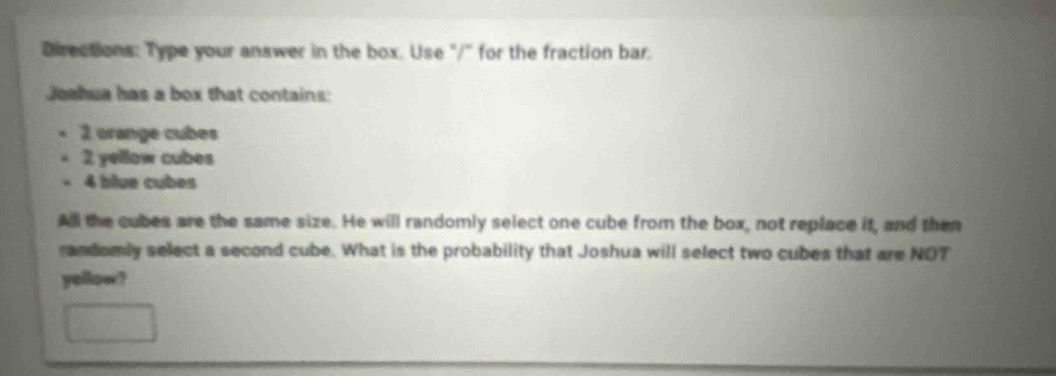
directions: type your answer in the box. use \/\ for the fraction bar. joshua has a box that contains: - 2 orange cubes - 2 yellow cubes - 4 blue cubes all the cubes are the same size. he will randomly select one cube from the box, not replace it, and then randomly select a second cube. what is the probability that joshua will select two cubes that are not yellow?
Answer
Answer:
$\frac{15}{28}$
Explanation:
Step1: Calculate total number of cubes
$2 + 2+4=8$
Step2: Calculate probability of first - non - yellow cube
There are $8 - 2 = 6$ non - yellow cubes out of 8. So the probability of selecting a non - yellow cube first is $\frac{6}{8}$.
Step3: Calculate probability of second - non - yellow cube
Since the first cube is not replaced, there are now 7 cubes left and $6 - 1=5$ non - yellow cubes left. So the probability of selecting a non - yellow cube second is $\frac{5}{7}$.
Step4: Calculate combined probability
By the multiplication rule for independent events (in the non - replacement case, sequential probabilities), the probability of both events is $\frac{6}{8}\times\frac{5}{7}=\frac{30}{56}=\frac{15}{28}$.