the distances from earth (in light - years) to twelve of the closest and brightest stars are listed. find…
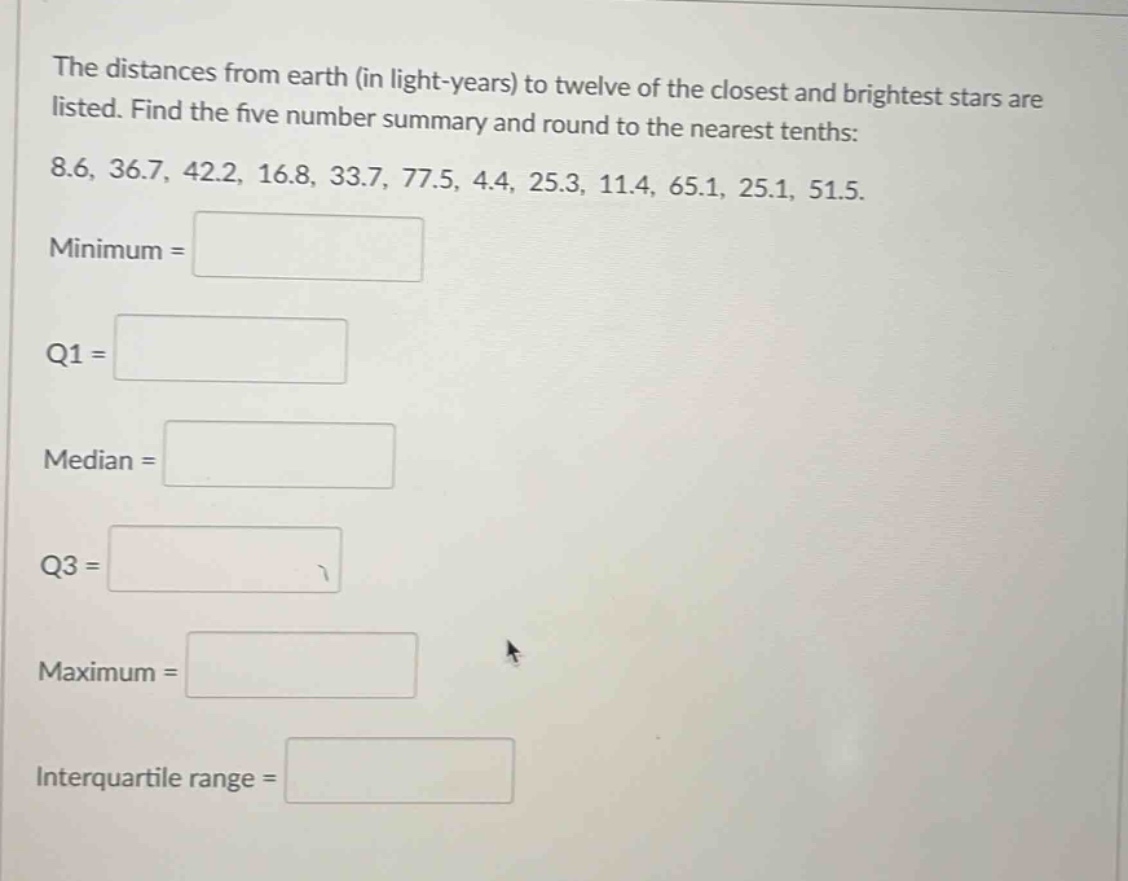
the distances from earth (in light - years) to twelve of the closest and brightest stars are listed. find the five number summary and round to the nearest tenths: 8.6, 36.7, 42.2, 16.8, 33.7, 77.5, 4.4, 25.3, 11.4, 65.1, 25.1, 51.5. minimum = q1 = median = q3 = maximum = interquartile range =
Answer
Explanation:
Step1: Sort the data
$4.4, 8.6, 11.4, 16.8, 25.1, 25.3, 33.7, 36.7, 42.2, 51.5, 65.1, 77.5$
Step2: Find the minimum
The minimum value is the smallest number in the sorted - data set. So, the minimum is $4.4$.
Step3: Find the first quartile (Q1)
Since $n = 12$ (the number of data points), the position of Q1 is $\frac{n + 1}{4}=\frac{12+1}{4}=3.25$. The value of Q1 is $11.4+(0.25)\times(16.8 - 11.4)=11.4 + 1.35=12.8$.
Step4: Find the median
Since $n = 12$ (an even - numbered data set), the median is the average of the $\frac{n}{2}$th and $(\frac{n}{2}+1)$th ordered data values. The $\frac{n}{2}=6$th and $\frac{n}{2}+1 = 7$th values are $25.3$ and $33.7$ respectively. Median$=\frac{25.3 + 33.7}{2}=\frac{59}{2}=29.5$.
Step5: Find the third quartile (Q3)
The position of Q3 is $3\times\frac{n + 1}{4}=3\times\frac{12 + 1}{4}=9.75$. The value of Q3 is $42.2+(0.75)\times(51.5 - 42.2)=42.2+6.975 = 49.2$.
Step6: Find the maximum
The maximum value is the largest number in the sorted - data set. So, the maximum is $77.5$.
Step7: Find the inter - quartile range (IQR)
IQR = Q3 - Q1. So, IQR$=49.2-12.8 = 36.4$.
Answer:
Minimum = $4.4$ Q1 = $12.8$ Median = $29.5$ Q3 = $49.2$ Maximum = $77.5$ Interquartile range = $36.4$