the distribution of the heights of five - year - old children has a mean of 42.5 inches. a pediatrician…
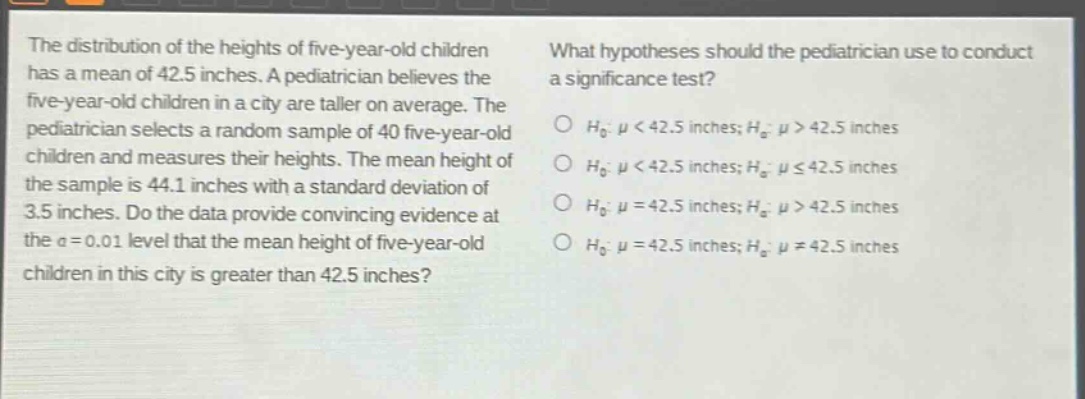
the distribution of the heights of five - year - old children has a mean of 42.5 inches. a pediatrician believes the five - year - old children in a city are taller on average. the pediatrician selects a random sample of 40 five - year - old children and measures their heights. the mean height of the sample is 44.1 inches with a standard deviation of 3.5 inches. do the data provide convincing evidence at the $alpha = 0.01$ level that the mean height of five - year - old children in this city is greater than 42.5 inches? what hypotheses should the pediatrician use to conduct a significance test? $h_0:mu<42.5$ inches; $h_a:mu > 42.5$ inches $h_0:mu<42.5$ inches; $h_a:muleq42.5$ inches $h_0:mu = 42.5$ inches; $h_a:mu>42.5$ inches $h_0:mu = 42.5$ inches; $h_a:mu\neq42.5$ inches
Answer
Explanation:
Step1: Define null and alternative hypotheses
The null hypothesis $H_0$ is a statement of no - effect or no difference. The alternative hypothesis $H_a$ is what we are trying to find evidence for. Here, the population mean is $\mu$. The current known mean height of five - year - old children is 42.5 inches. The pediatrician believes the children in the city are taller on average. So, the null hypothesis is that the mean height of children in the city is equal to the known mean height, and the alternative hypothesis is that the mean height of children in the city is greater than the known mean height. $H_0:\mu = 42.5$ inches; $H_a:\mu>42.5$ inches
Answer:
$H_0:\mu = 42.5$ inches; $H_a:\mu>42.5$ inches