the distribution of the number of blocks a young child can stack before their tower falls is approximately…
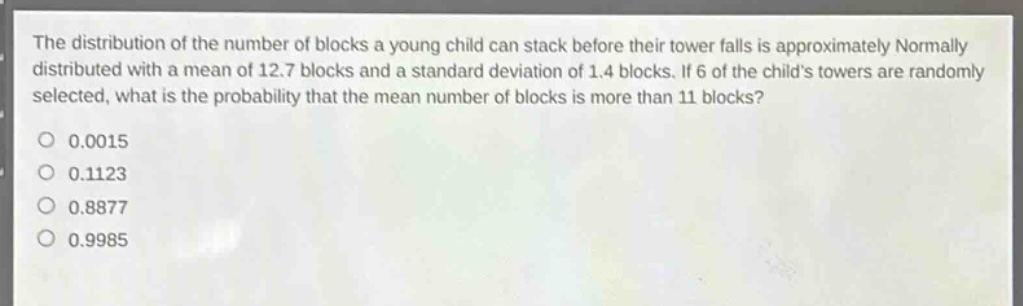
the distribution of the number of blocks a young child can stack before their tower falls is approximately normally distributed with a mean of 12.7 blocks and a standard deviation of 1.4 blocks. if 6 of the childs towers are randomly selected, what is the probability that the mean number of blocks is more than 11 blocks?\n0.0015\n0.1123\n0.8877\n0.9985
Answer
Explanation:
Step1: Calculate the standard error
The formula for the standard error of the mean is $\sigma_{\bar{x}}=\frac{\sigma}{\sqrt{n}}$, where $\sigma$ is the population standard deviation and $n$ is the sample size. Given $\sigma = 1.4$ and $n = 6$, then $\sigma_{\bar{x}}=\frac{1.4}{\sqrt{6}}\approx0.5715$.
Step2: Calculate the z - score
The z - score formula is $z=\frac{\bar{x}-\mu}{\sigma_{\bar{x}}}$, where $\bar{x}$ is the sample mean, $\mu$ is the population mean. Here, $\mu = 12.7$, $\bar{x}=11$, so $z=\frac{11 - 12.7}{0.5715}=\frac{- 1.7}{0.5715}\approx - 2.97$.
Step3: Find the probability
We want $P(\bar{X}>11)$, which is equivalent to $P(Z>-2.97)$. Since $P(Z > - 2.97)=1 - P(Z\leqslant - 2.97)$. Looking up $P(Z\leqslant - 2.97)$ in the standard normal table, we get $P(Z\leqslant - 2.97)=0.0015$. So $P(Z > - 2.97)=1 - 0.0015 = 0.9985$.
Answer:
0.9985