drag each example to the correct location on the chart. identify each example as a discrete random variable…
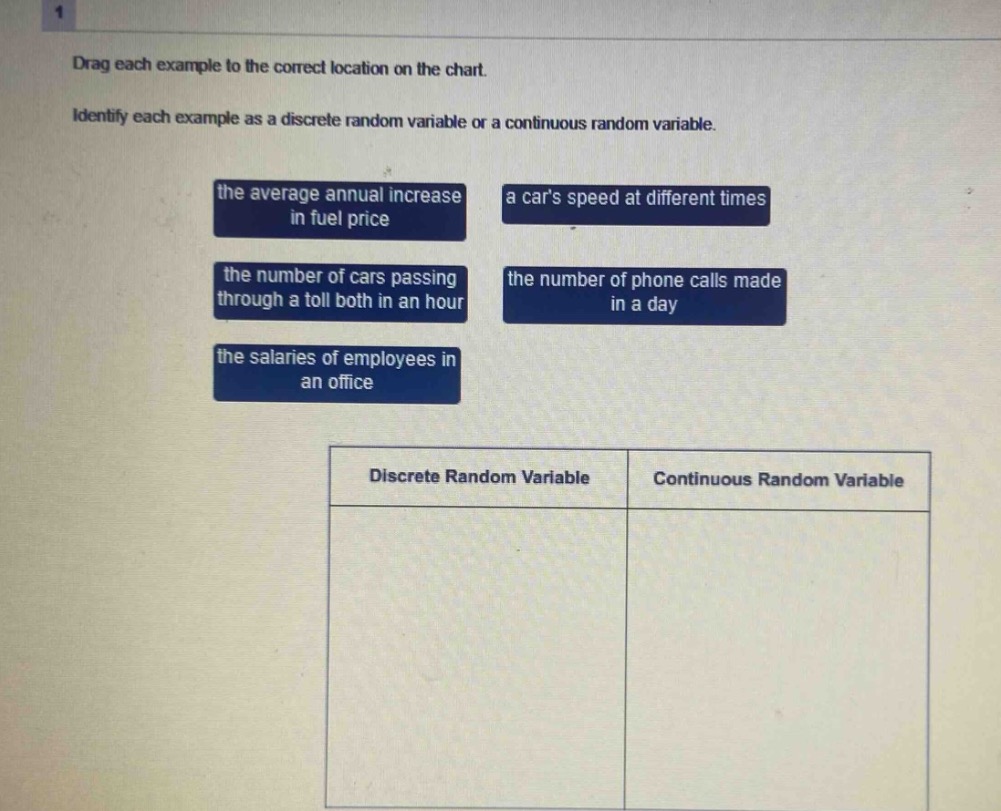
drag each example to the correct location on the chart. identify each example as a discrete random variable or a continuous random variable. the average annual increase in fuel price a cars speed at different times the number of cars passing through a toll both in an hour the number of phone calls made in a day the salaries of employees in an office discrete random variable continuous random variable
Answer
Explanation:
Step1: Recall definitions
Discrete random variables take on countable values. Continuous random variables can take on any value in an interval.
Step2: Analyze "the average annual increase in fuel price"
It can take any value in an interval, so it's continuous.
Step3: Analyze "a car's speed at different times"
Speed can take any value in an interval, so it's continuous.
Step4: Analyze "the number of cars passing through a toll booth in an hour"
The number of cars is countable, so it's discrete.
Step5: Analyze "the number of phone calls made in a day"
The number of phone - calls is countable, so it's discrete.
Step6: Analyze "the salaries of employees in an office"
Salaries can take any value in a range (e.g., $3000.50, $3000.75 etc.), so it's continuous.
Answer:
Discrete Random Variable: the number of cars passing through a toll booth in an hour, the number of phone calls made in a day Continuous Random Variable: the average annual increase in fuel price, a car's speed at different times, the salaries of employees in an office