drag each game to the correct location on the chart. tickets for all of the described charity raffle games…
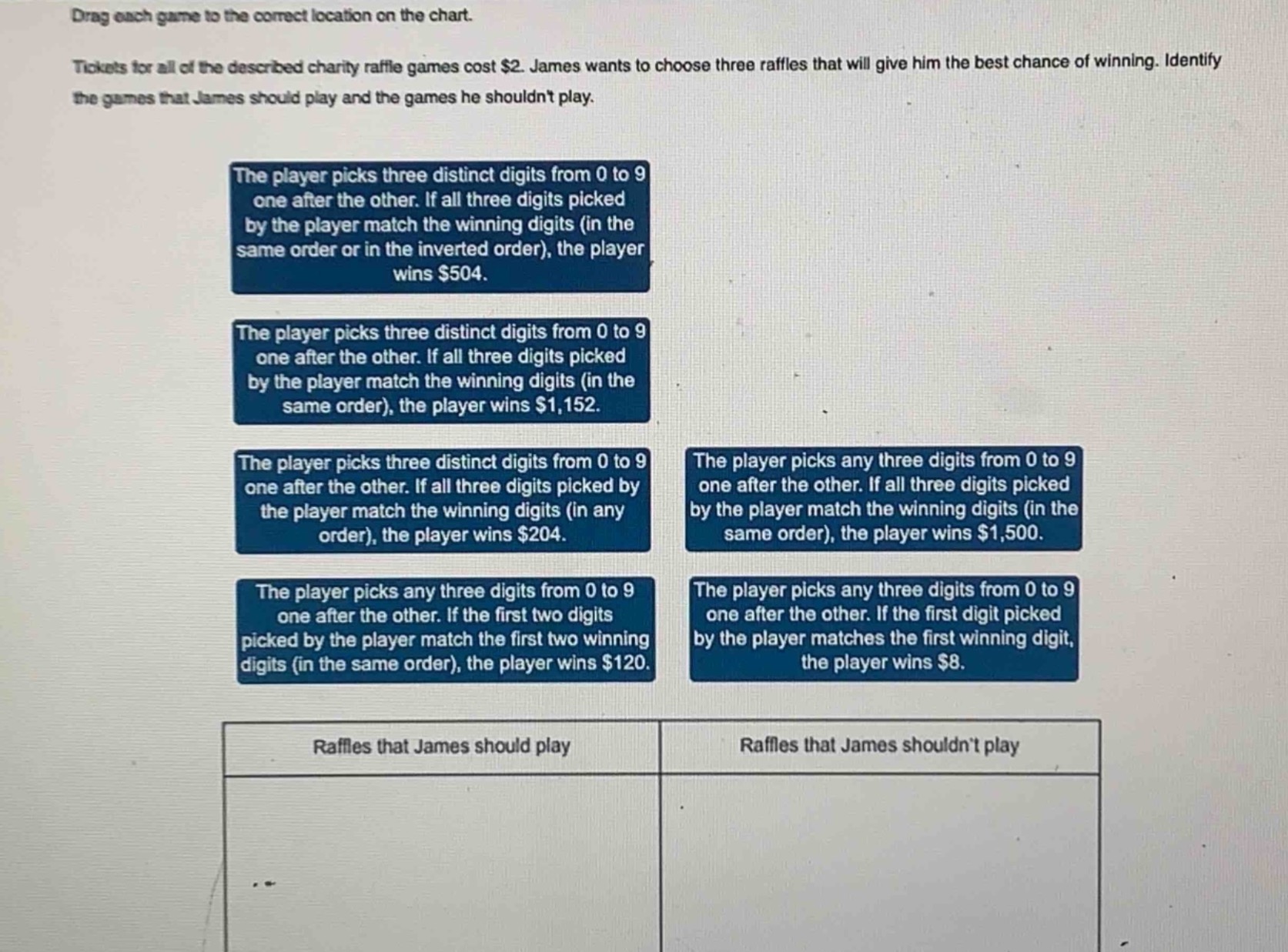
drag each game to the correct location on the chart. tickets for all of the described charity raffle games cost $2. james wants to choose three raffles that will give him the best chance of winning. identify the games that james should play and the games he shouldnt play. the player picks three distinct digits from 0 to 9 one after the other. if all three digits picked by the player match the winning digits (in the same order or in the inverted order), the player wins $504. the player picks three distinct digits from 0 to 9 one after the other. if all three digits picked by the player match the winning digits (in the same order), the player wins $1,152. the player picks three distinct digits from 0 to 9 one after the other. if all three digits picked by the player match the winning digits (in any order), the player wins $204. the player picks any three digits from 0 to 9 one after the other. if all three digits picked by the player match the winning digits (in the same order), the player wins $1,500. the player picks any three digits from 0 to 9 one after the other. if the first two digits picked by the player match the first two winning digits (in the same order), the player wins $120. the player picks any three digits from 0 to 9 one after the other. if the first digit picked by the player matches the first winning digit, the player wins $8. raffles that james should play raffles that james shouldnt play
Answer
Answer:
Raffles that James should play:
- The player picks any three digits from 0 to 9 one - after the other. If the first digit picked by the player matches the first winning digit, the player wins $8.
- The player picks any three digits from 0 to 9 one after the other. If the first two digits picked by the player match the first two winning digits (in the same order), the player wins $120.
- The player picks three distinct digits from 0 to 9 one after the other. If all three digits picked by the player match the winning digits (in any order), the player wins $204.
Raffles that James shouldn't play:
- The player picks three distinct digits from 0 to 9 one after the other. If all three digits picked by the player match the winning digits (in the same order), the player wins $1,152.
- The player picks three distinct digits from 0 to 9 one after the other. If all three digits picked by the player match the winning digits (in the same order or in the inverted order), the player wins $504.
- The player picks any three digits from 0 to 9 one after the other. If all three digits picked by the player match the winning digits (in the same order), the player wins $1,500.
Explanation:
Step1: Calculate number of possible outcomes for distinct - digit cases
For picking 3 distinct digits from 10 digits (0 - 9), the number of permutations is $P(10,3)=\frac{10!}{(10 - 3)!}=10\times9\times8 = 720$. For the cases where order matters (matching in the same order), the probability of winning is $\frac{1}{720}$. For the case of matching in the same or inverted order, the probability is $\frac{2}{720}$. For matching in any order, we use combinations. The number of combinations of 3 distinct digits out of 10 is $C(10,3)=\frac{10!}{3!(10 - 3)!}=120$, so the probability of winning is $\frac{1}{120}$.
Step2: Calculate number of possible outcomes for non - distinct digit cases
For picking any 3 digits from 10 digits (0 - 9), the number of possible outcomes is $10\times10\times10=1000$. For matching only the first digit, the probability of winning is $\frac{1}{10}$. For matching the first two digits, the probability of winning is $\frac{1}{10\times10}=\frac{1}{100}$. For matching all three digits in order, the probability is $\frac{1}{1000}$.
Step3: Compare probabilities
The games with higher probabilities of winning are the ones where fewer digits need to match or where the order requirements are less strict. The games with lower probabilities are the ones where all three digits must match in a specific order. So, James should play the games with higher probability of winning and avoid the ones with lower probability of winning.