drag each tile to the correct box. a six - sided fair die is rolled two times. arrange the events in order…
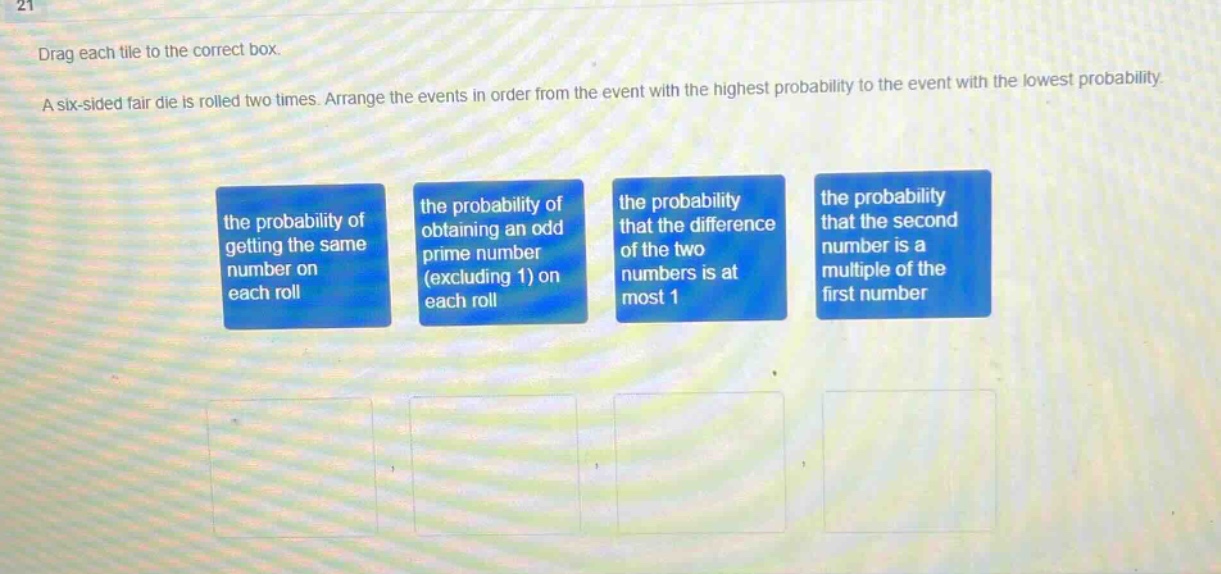
drag each tile to the correct box. a six - sided fair die is rolled two times. arrange the events in order from the event with the highest probability to the event with the lowest probability. the probability of getting the same number on each roll the probability of obtaining an odd prime number (excluding 1) on each roll the probability that the difference of the two numbers is at most 1 the probability that the second number is a multiple of the first number
Answer
Explanation:
Step1: Calcular el total de resultados posibles
Al lanzar un dado de seis caras dos veces, el número total de resultados posibles es $n(S)=6\times6 = 36$.
Step2: Calcular la probabilidad de obtener el mismo número en cada lanzamiento
Los casos favorables son $(1,1),(2,2),(3,3),(4,4),(5,5),(6,6)$, es decir $n_1 = 6$. Entonces $P_1=\frac{n_1}{n(S)}=\frac{6}{36}=\frac{1}{6}$.
Step3: Calcular la probabilidad de obtener un número primo impar (excluyendo 1) en cada lanzamiento
Los números primos impares entre 1 y 6 son 3 y 5. Los casos favorables son $(3,3),(3,5),(5,3),(5,5)$, es decir $n_2 = 4$. Entonces $P_2=\frac{n_2}{n(S)}=\frac{4}{36}=\frac{1}{9}$.
Step4: Calcular la probabilidad de que la diferencia de los dos números sea a lo sumo 1
Los casos favorables son: $(1,1),(1,2),(2,1),(2,2),(2,3),(3,2),(3,3),(3,4),(4,3),(4,4),(4,5),(5,4),(5,5),(5,6),(6,5),(6,6)$, es decir $n_3 = 16$. Entonces $P_3=\frac{n_3}{n(S)}=\frac{16}{36}=\frac{4}{9}$.
Step5: Calcular la probabilidad de que el segundo número sea múltiplo del primer número
Los casos favorables son: $(1,1),(1,2),(1,3),(1,4),(1,5),(1,6),(2,2),(2,4),(2,6),(3,3),(3,6),(4,4),(5,5),(6,6)$, es decir $n_4 = 14$. Entonces $P_4=\frac{n_4}{n(S)}=\frac{14}{36}=\frac{7}{18}$.
Step6: Ordenar las probabilidades
$\frac{4}{9}>\frac{7}{18}>\frac{1}{6}>\frac{1}{9}$.
Answer:
the probability that the difference of the two numbers is at most 1, the probability that the second number is a multiple of the first number, the probability of getting the same number on each roll, the probability of obtaining an odd prime number (excluding 1) on each roll