a drawer contains two pairs of red socks, three pairs of yellow socks, and one pair of black socks. one sock…
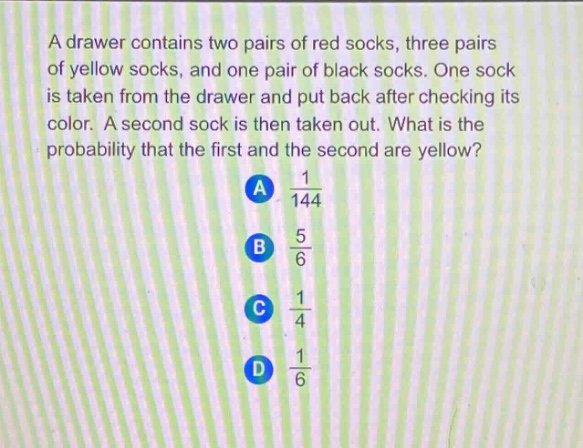
a drawer contains two pairs of red socks, three pairs of yellow socks, and one pair of black socks. one sock is taken from the drawer and put back after checking its color. a second sock is then taken out. what is the probability that the first and the second are yellow? a $\frac{1}{144}$ b $\frac{5}{6}$ c $\frac{1}{4}$ d $\frac{1}{6}$
Answer
Answer:
C. $\frac{1}{4}$
Explanation:
Step1: Calculate total number of socks
There are $(2 + 3+1)\times2=12$ socks.
Step2: Calculate probability of first - yellow sock
There are $3\times2 = 6$ yellow socks. Probability of first yellow sock $P_1=\frac{6}{12}=\frac{1}{2}$.
Step3: Calculate probability of second - yellow sock
Since sock is replaced, total number of socks is still 12. Probability of second yellow sock $P_2=\frac{6}{12}=\frac{1}{2}$.
Step4: Calculate combined probability
Since the two events are independent, $P = P_1\times P_2=\frac{1}{2}\times\frac{1}{2}=\frac{1}{4}$.