the drug oxycontin (oxycodone) is used to treat pain, but it is dangerous because it is addictive and can be…
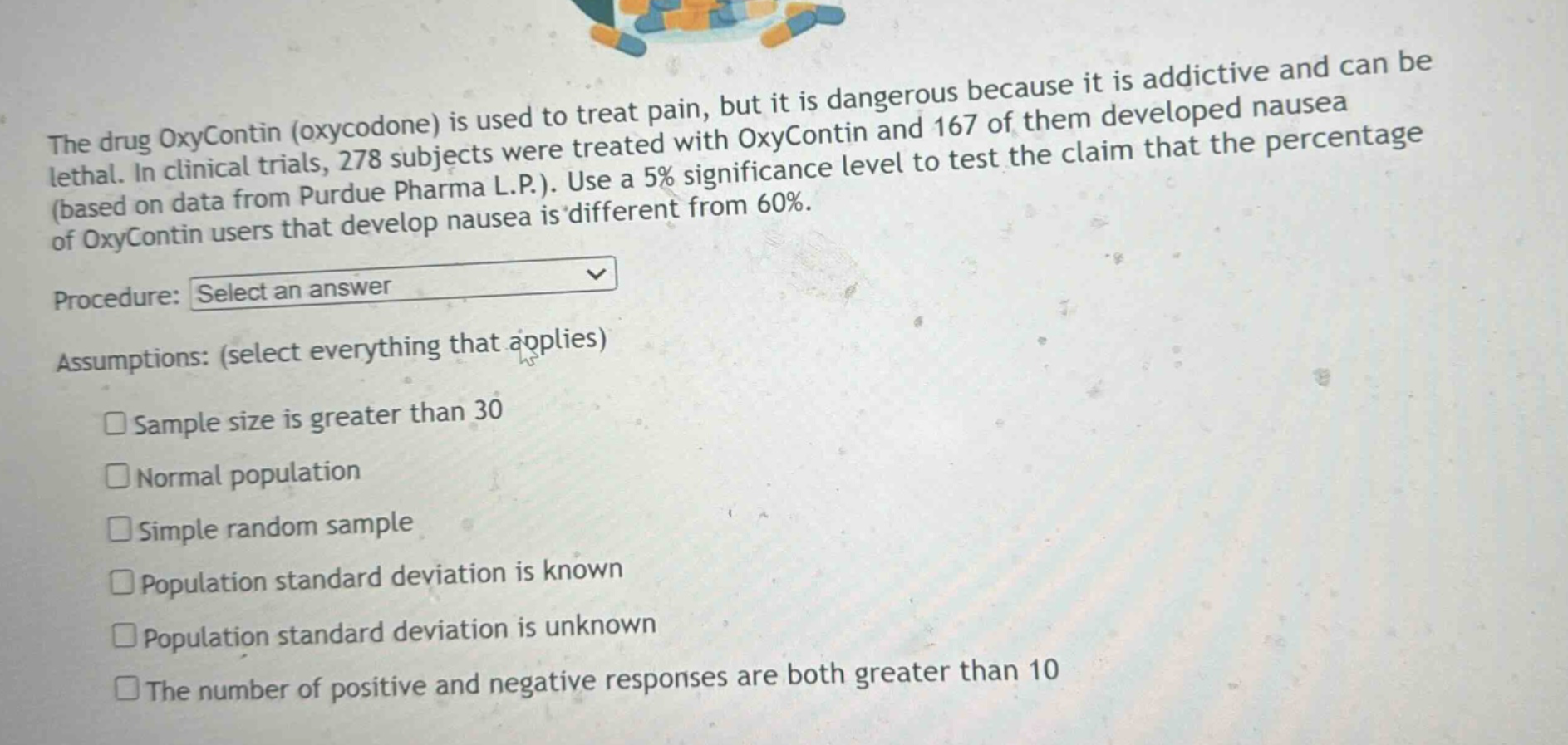
the drug oxycontin (oxycodone) is used to treat pain, but it is dangerous because it is addictive and can be lethal. in clinical trials, 278 subjects were treated with oxycontin and 167 of them developed nausea (based on data from purdue pharma l.p.). use a 5% significance level to test the claim that the percentage of oxycontin users that develop nausea is different from 60%. procedure: select an answer assumptions: (select everything that applies) sample size is greater than 30 normal population simple random sample population standard deviation is known population standard deviation is unknown the number of positive and negative responses are both greater than 10
Answer
Explanation:
Step1: Identify the test - type
This is a hypothesis test for a proportion.
Step2: Check assumptions
- The sample size $n = 278>30$.
- We assume it is a simple random sample.
- The number of positive responses $x = 167$ and negative responses $n - x=278 - 167 = 111$, both are greater than 10. We do not need to assume a normal population (since the sample - size conditions for the normal approximation to the binomial are met), and we are dealing with proportions so the concept of population standard deviation in the traditional sense for means does not apply here.
Assumptions:
- Sample size is greater than 30
- Simple random sample
- The number of positive and negative responses are both greater than 10
Answer:
Sample size is greater than 30, Simple random sample, The number of positive and negative responses are both greater than 10