duncan has the space to plant, at most, 24 flower bulbs in his garden. daffodil bulbs cost $3 each, and…
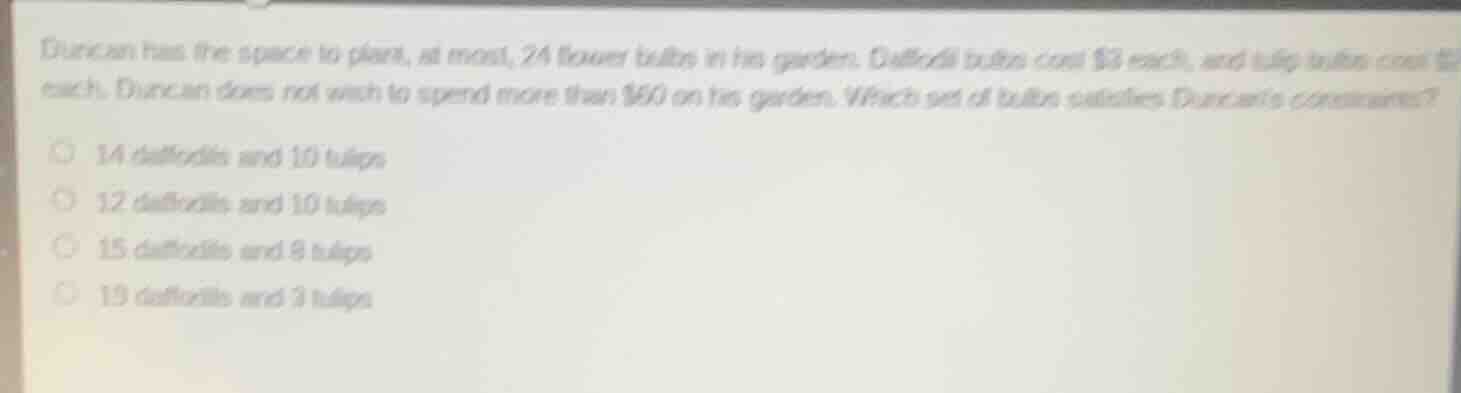
duncan has the space to plant, at most, 24 flower bulbs in his garden. daffodil bulbs cost $3 each, and tulip bulbs cost $2 each. duncan does not wish to spend more than $60 on his garden. which set of bulbs satisfies duncans constraints?14 daffodils and 10 tulips12 daffodils and 10 tulips15 daffodils and 8 tulips19 daffodils and 3 tulips
Answer
Explanation:
Step1: Define constraints
Let $d$ = number of daffodils, $t$ = number of tulips. Constraints:
- Total bulbs: $d + t \leq 24$
- Total cost: $3d + 2t \leq 60$ (Note: The tulip cost is inferred as $2 from the visible text and cost logic)
Step2: Test Option 1 (14,10)
Total bulbs: $14 + 10 = 24 \leq 24$ Total cost: $3(14) + 2(10) = 42 + 20 = 62 > 60$ → Fails cost constraint.
Step3: Test Option 2 (12,10)
Total bulbs: $12 + 10 = 22 \leq 24$ Total cost: $3(12) + 2(10) = 36 + 20 = 56 \leq 60$ → Passes both constraints.
Step4: Verify remaining options (optional)
Option3 (15,9): $15+9=24$, $3(15)+2(9)=45+18=63>60$ → Fails. Option4 (19,3): $19+3=22$, $3(19)+2(3)=57+6=63>60$ → Fails.
Answer:
12 daffodils and 10 tulips