in early 2019, the us rate of recycling plastic water bottles was only 23%. a government agency designs an…
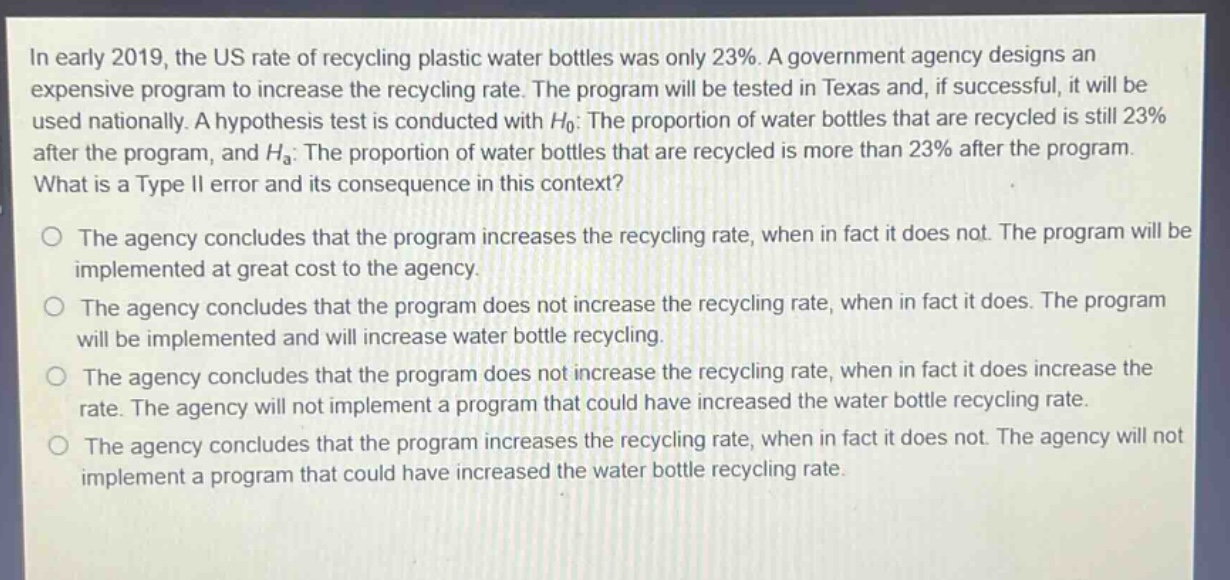
in early 2019, the us rate of recycling plastic water bottles was only 23%. a government agency designs an expensive program to increase the recycling rate. the program will be tested in texas and, if successful, it will be used nationally. a hypothesis test is conducted with $h_0$: the proportion of water bottles that are recycled is still 23% after the program, and $h_a$: the proportion of water bottles that are recycled is more than 23% after the program. what is a type ii error and its consequence in this context?\no the agency concludes that the program increases the recycling rate, when in fact it does not. the program will be implemented at great cost to the agency.\no the agency concludes that the program does not increase the recycling rate, when in fact it does. the program will be implemented and will increase water bottle recycling.\no the agency concludes that the program does not increase the recycling rate, when in fact it does increase the rate. the agency will not implement a program that could have increased the water bottle recycling rate.\no the agency concludes that the program increases the recycling rate, when in fact it does not. the agency will not implement a program that could have increased the water bottle recycling rate.
Answer
Brief Explanations:
A Type II error occurs when we fail to reject a false null hypothesis. In this case, the null hypothesis $H_0$ is that the proportion of recycled water - bottles is still 23% after the program. So, a Type II error is when the agency concludes that the program does not increase the recycling rate (fails to reject $H_0$) when in fact it does ( $H_0$ is false). The consequence is that the agency will not implement a program that could have increased the water - bottle recycling rate.
Answer:
The agency concludes that the program does not increase the recycling rate, when in fact it does increase the rate. The agency will not implement a program that could have increased the water bottle recycling rate.