earths surface area is (5.10\times10^{8} km^{2}), and its crust has a mean thickness of (35.1 km) and mean…
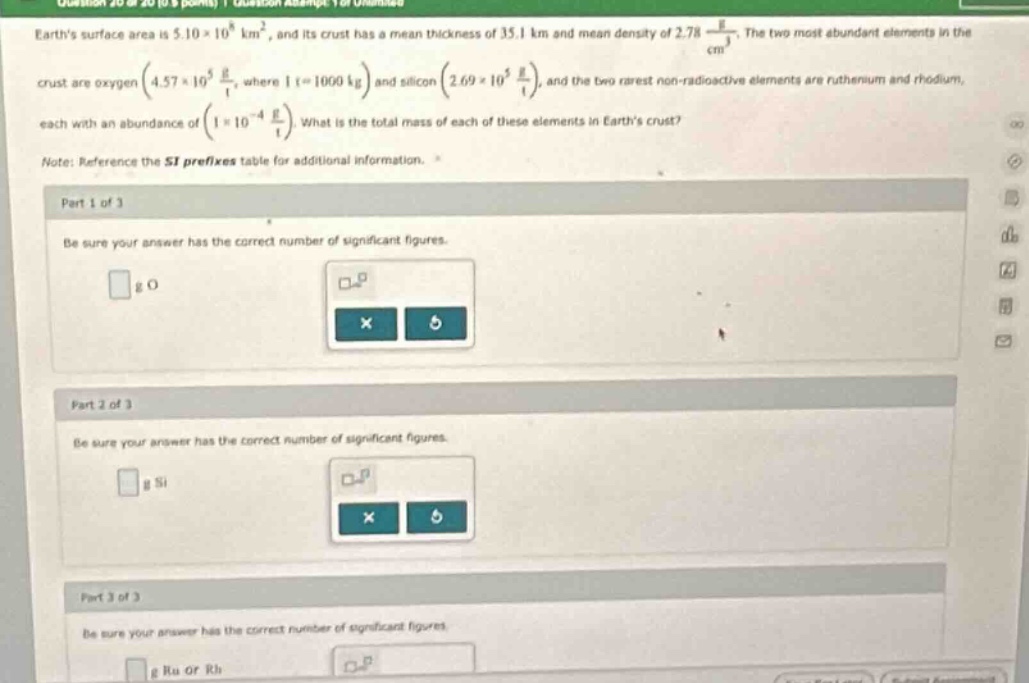
earths surface area is (5.10\times10^{8} km^{2}), and its crust has a mean thickness of (35.1 km) and mean density of (2.78\frac{g}{cm^{3}}). the two most abundant elements in the crust are oxygen ((4.57\times10^{5}\frac{t}{t}), where (1 t = 1000 kg)) and silicon ((2.69\times10^{5}\frac{t}{t})), and the two rarest non - radioactive elements are ruthenium and rhodium, each with an abundance of ((1\times10^{-4}\frac{t}{t})). what is the total mass of each of these elements in earths crust?\nnote: reference the si prefixes table for additional information.\npart 1 of 3\nbe sure your answer has the correct number of significant figures.\n g o\npart 2 of 3\nbe sure your answer has the correct number of significant figures.\n g si\npart 3 of 3\nbe sure your answer has the correct number of significant figures.\n g ru or rh
Answer
Explanation:
Step1: Calculate the volume of Earth's crust
First, convert the surface - area and thickness to SI units. The surface area $A = 5.10\times10^{8}\ km^{2}=5.10\times10^{8}\times(10^{3})^{2}\ m^{2}=5.10\times10^{14}\ m^{2}$, and the thickness $h = 35.1\ km = 35.1\times10^{3}\ m$. The volume of the crust $V=A\times h$. $V=(5.10\times 10^{14}\ m^{2})\times(35.1\times10^{3}\ m)=1.7901\times10^{18}\ m^{3}$
Step2: Convert the density to SI units
The density of the crust $\rho = 2.78\ g/cm^{3}=2.78\times10^{3}\ kg/m^{3}$
Step3: Calculate the mass of the crust
Using the formula $m=\rho V$, we have $m=(2.78\times 10^{3}\ kg/m^{3})\times(1.7901\times10^{18}\ m^{3}) = 4.976478\times10^{21}\ kg$
Step4: Calculate the mass of oxygen
The abundance of oxygen is $4.57\times10^{5}\ \frac{t}{t}$, and since $1\ t = 1000\ kg$, the mass of oxygen $m_O$ is $m_O=(4.57\times10^{5}\times1000\ kg/t)\times m$. $m_O=(4.57\times10^{8}\ kg/t)\times(4.976478\times10^{21}\ kg)=2.27424\times10^{30}\ kg = 2.27\times10^{33}\ g$
Step5: Calculate the mass of silicon
The abundance of silicon is $2.69\times10^{5}\ \frac{t}{t}$, and the mass of silicon $m_{Si}$ is $m_{Si}=(2.69\times10^{5}\times1000\ kg/t)\times m$. $m_{Si}=(2.69\times10^{8}\ kg/t)\times(4.976478\times10^{21}\ kg)=1.33867\times10^{30}\ kg = 1.34\times10^{33}\ g$
Step6: Calculate the mass of ruthenium or rhodium
The abundance of ruthenium or rhodium is $1\times10^{-4}\ \frac{t}{t}$, and the mass of ruthenium or rhodium $m_{Ru/Rh}$ is $m_{Ru/Rh}=(1\times10^{-4}\times1000\ kg/t)\times m$. $m_{Ru/Rh}=(1\times10^{-1}\ kg/t)\times(4.976478\times10^{21}\ kg)=4.976478\times10^{20}\ kg = 4.98\times10^{23}\ g$
Answer:
Part 1 of 3: $2.27\times10^{33}$ Part 2 of 3: $1.34\times10^{33}$ Part 3 of 3: $4.98\times10^{23}$