easton has a bag that contains orange chews, cherry chews, and peach chews. he performs an experiment…
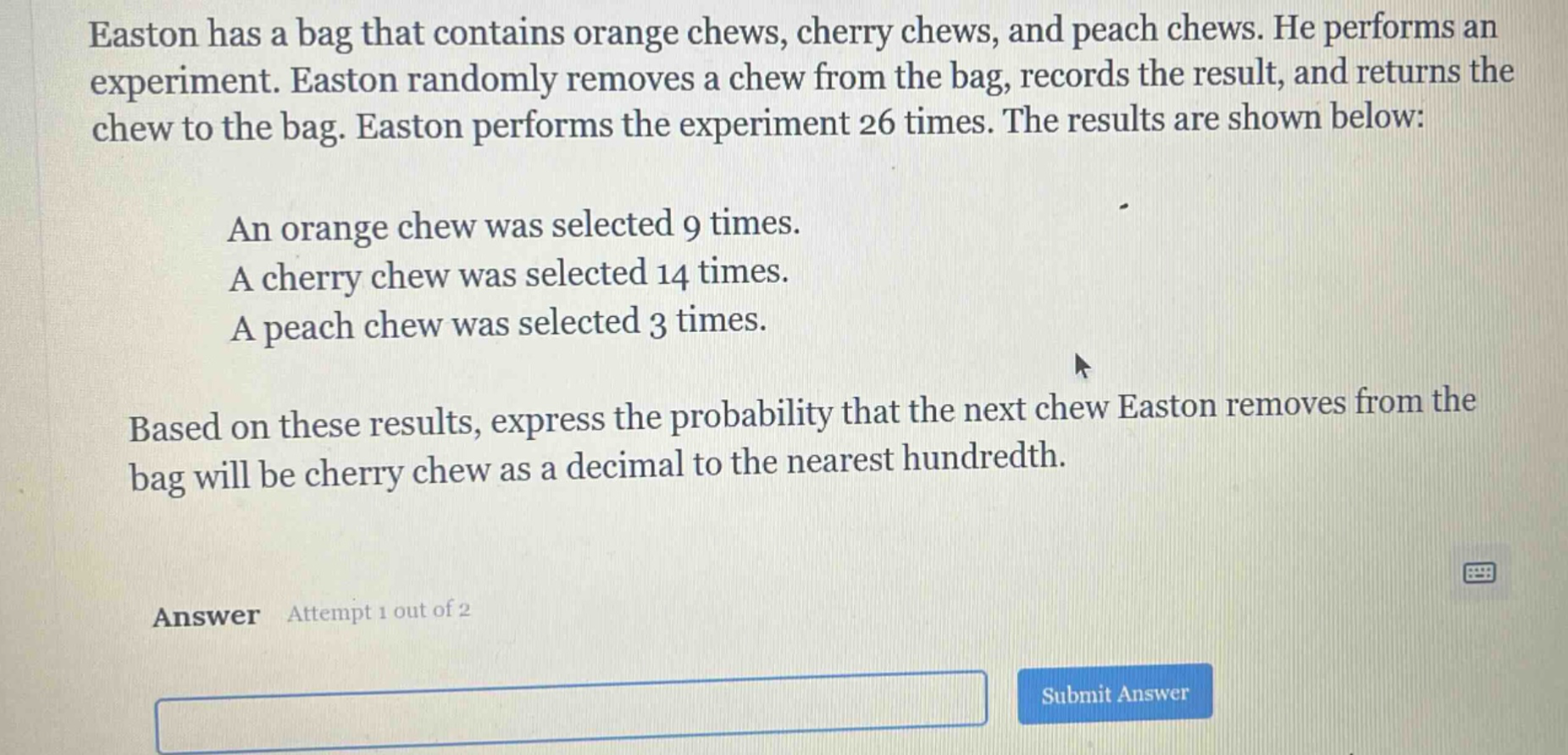
easton has a bag that contains orange chews, cherry chews, and peach chews. he performs an experiment. easton randomly removes a chew from the bag, records the result, and returns the chew to the bag. easton performs the experiment 26 times. the results are shown below: an orange chew was selected 9 times. a cherry chew was selected 14 times. a peach chew was selected 3 times. based on these results, express the probability that the next chew easton removes from the bag will be cherry chew as a decimal to the nearest hundredth. answer attempt 1 out of 2
Answer
Explanation:
Step1: Definir la fórmula de probabilidad experimental
La probabilidad experimental $P(E)$ se define como $P(E)=\frac{\text{número de veces que el evento ocurre}}{\text{número total de ensayos}}$.
Step2: Identificar los valores
El número de veces que se seleccionó un caramelo de cereza es $14$ (número de veces que el evento ocurre), y el número total de ensayos es $26$ (intentos de extraer un caramelo).
Step3: Calcular la probabilidad
$P(\text{caramelo de cereza})=\frac{14}{26}\approx0.54$
Answer:
$0.54$