eight identical slips of paper, each containing one number from one to eight, inclusive, are mixed up inside…
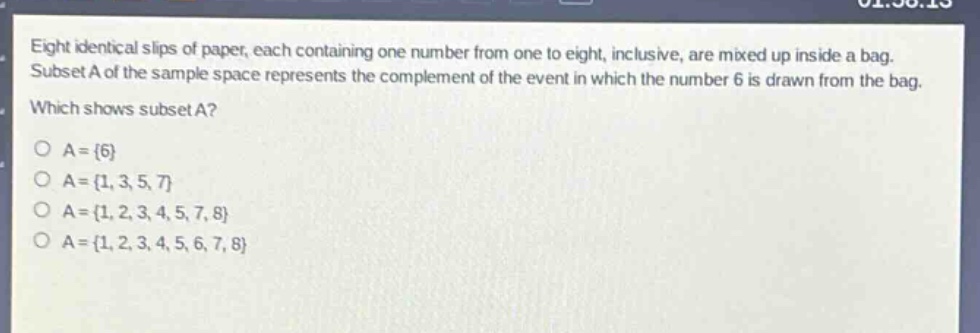
eight identical slips of paper, each containing one number from one to eight, inclusive, are mixed up inside a bag. subset a of the sample space represents the complement of the event in which the number 6 is drawn from the bag. which shows subset a?\no a = {6}\no a = {1, 3, 5, 7}\no a = {1, 2, 3, 4, 5, 7, 8}\no a = {1, 2, 3, 4, 5, 6, 7, 8}
Answer
Answer:
C. $A = {1,2,3,4,5,7,8}$
Explanation:
Step1: Define the sample space
The sample space $S={1,2,3,4,5,6,7,8}$.
Step2: Define the event
The event $E$ is drawing the number 6. So $E = {6}$.
Step3: Find the complement
The complement of an event $E$, denoted as $E^c$ or $\overline{E}$, contains all the elements in the sample - space that are not in $E$. So $A=\overline{E}={1,2,3,4,5,7,8}$.