eli chooses two shirts from a group of five to pack for a weekend trip. let each shirt be represented by a…
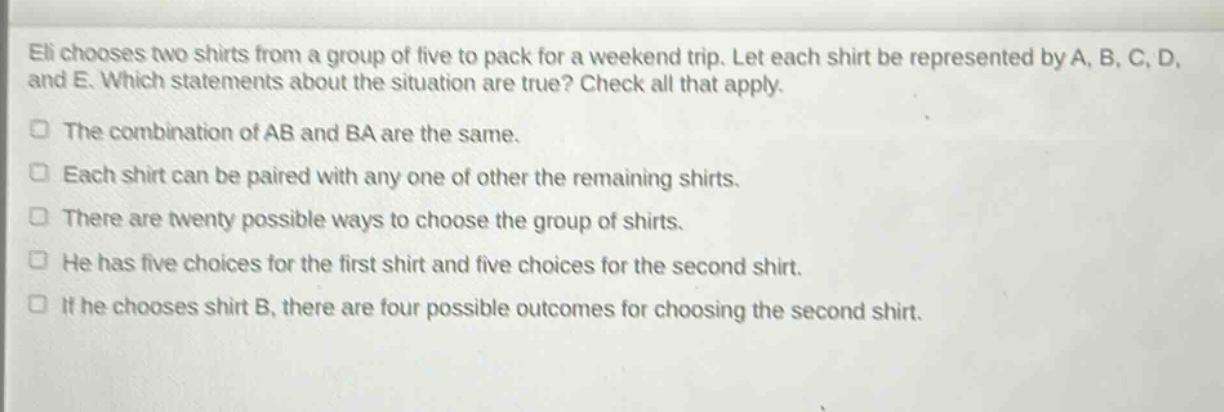
eli chooses two shirts from a group of five to pack for a weekend trip. let each shirt be represented by a, b, c, d, and e. which statements about the situation are true? check all that apply. the combination of ab and ba are the same. each shirt can be paired with any one of other the remaining shirts. there are twenty possible ways to choose the group of shirts. he has five choices for the first shirt and five choices for the second shirt. if he chooses shirt b, there are four possible outcomes for choosing the second shirt.
Answer
Explanation:
Step1: Understand combination concept
In combinations, order doesn't matter. So AB and BA are the same combination.
Step2: Analyze shirt - pairing
For each shirt, there are 4 remaining shirts to pair with. For example, if we consider one shirt, we can pair it with any of the other 4.
Step3: Calculate number of combinations
The formula for combinations is $C(n,r)=\frac{n!}{r!(n - r)!}$, where $n = 5$ and $r=2$. $C(5,2)=\frac{5!}{2!(5 - 2)!}=\frac{5\times4\times3!}{2\times1\times3!}=10$, not 20.
Step4: Analyze shirt - choice logic
For the first shirt, there are 5 choices. But for the second shirt, there are 4 remaining choices, not 5 again. If the first - chosen shirt is B, then there are 4 remaining shirts to choose from for the second shirt.
Answer:
The combination of AB and BA are the same. Each shirt can be paired with any one of the remaining shirts. If he chooses shirt B, there are four possible outcomes for choosing the second shirt.