eliza volunteers at a library. one day, she counts the number of books the first 20 people borrow. the list…
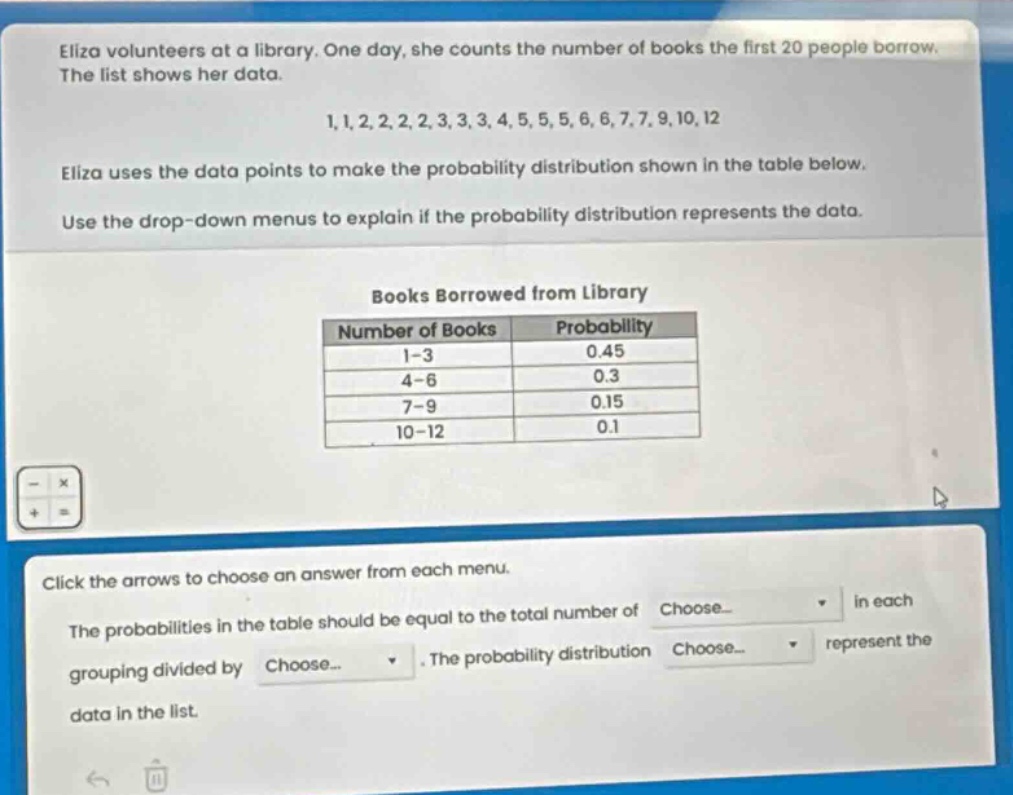
eliza volunteers at a library. one day, she counts the number of books the first 20 people borrow. the list shows her data.\n1,1,2,2,2,2,3,3,3,4,5,5,5,6,6,7,7,9,10,12\neliza uses the data points to make the probability distribution shown in the table below.\nuse the drop - down menus to explain if the probability distribution represents the data.\nbooks borrowed from library\n|number of books|probability|\n|----|----| \n|1 - 3|0.45|\n|4 - 6|0.3|\n|7 - 9|0.15|\n|10 - 12|0.1|\nclick the arrows to choose an answer from each menu.\nthe probabilities in the table should be equal to the total number of choose... in each grouping divided by choose... the probability distribution choose... represent the data in the list.
Answer
Answer:
The probabilities in the table should be equal to the total number of data - points in each grouping divided by 20. The probability distribution does represent the data in the list.
Explanation:
Step1: Calculate total number of data - points
There are 20 data - points in the list (since Eliza counted the number of books for the first 20 people).
Step2: Check 1 - 3 books group
The number of data - points in the 1 - 3 books group: 1,1,2,2,2,2,3,3,3 = 9. Probability = $\frac{9}{20}=0.45$.
Step3: Check 4 - 6 books group
The number of data - points in the 4 - 6 books group: 4,5,5,5,6,6 = 6. Probability = $\frac{6}{20}=0.3$.
Step4: Check 7 - 9 books group
The number of data - points in the 7 - 9 books group: 7,7,9 = 3. Probability = $\frac{3}{20}=0.15$.
Step5: Check 10 - 12 books group
The number of data - points in the 10 - 12 books group: 10,12 = 2. Probability = $\frac{2}{20}=0.1$. Since the calculated probabilities match the ones in the table, the probability distribution represents the data.