an engineer has designed a valve that will regulate water pressure on an automobile engine. the valve was…
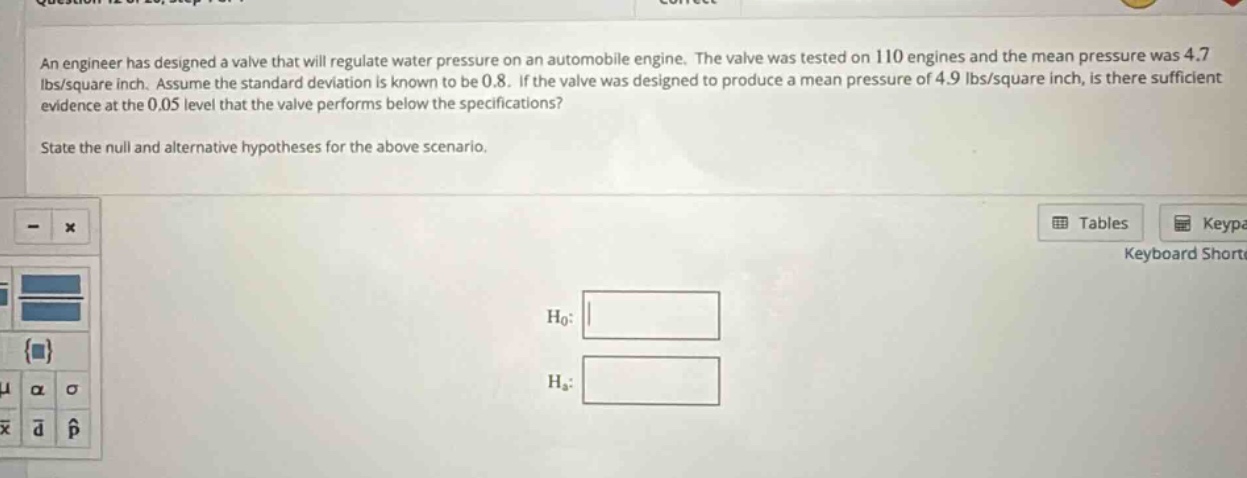
an engineer has designed a valve that will regulate water pressure on an automobile engine. the valve was tested on 110 engines and the mean pressure was 4.7 lbs/square inch. assume the standard deviation is known to be 0.8. if the valve was designed to produce a mean pressure of 4.9 lbs/square inch, is there sufficient evidence at the 0.05 level that the valve performs below the specifications? state the null and alternative hypotheses for the above scenario.
Answer
Explanation:
Step1: Define null hypothesis
The null hypothesis ($H_0$) is a statement of no - effect or no - difference. Here, it assumes the valve performs at or above the specifications. So, $H_0:\mu\geq4.9$.
Step2: Define alternative hypothesis
The alternative hypothesis ($H_a$) is what we are trying to find evidence for. Since we want to test if the valve performs below the specifications, $H_a:\mu < 4.9$.
Answer:
$H_0:\mu\geq4.9$ $H_a:\mu < 4.9$