which is equivalent to p(z ≥ 1.06)?\np(z ≤ 1.06)\np(z ≥ -1.06)\n1 - p(z ≤ 1.06)\ncomplete\nuse the standard…
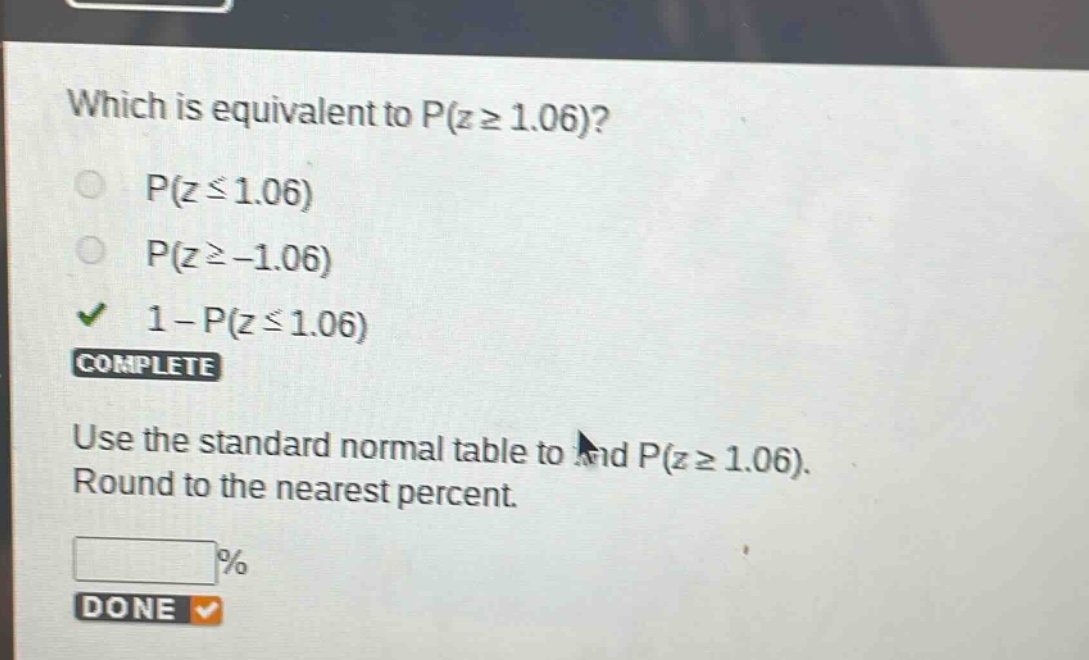
which is equivalent to p(z ≥ 1.06)?\np(z ≤ 1.06)\np(z ≥ -1.06)\n1 - p(z ≤ 1.06)\ncomplete\nuse the standard normal table to find p(z ≥ 1.06). round to the nearest percent.\n%
Answer
Explanation:
Step1: Recall the property of the standard - normal distribution
The total area under the standard - normal curve is 1, and $P(Z\leq z)+P(Z > z)=1$. For $z = 1.06$, we have $P(Z\geq1.06)=1 - P(Z\leq1.06)$.
Step2: Look up the value of $P(Z\leq1.06)$ in the standard - normal table
From the standard - normal table, $P(Z\leq1.06)=0.8554$.
Step3: Calculate $P(Z\geq1.06)$
$P(Z\geq1.06)=1 - P(Z\leq1.06)=1 - 0.8554 = 0.1446$.
Step4: Convert to percentage and round
$0.1446\times100% = 14.46%\approx14%$.
Answer:
14%