which is equivalent to p(z ≥ 1.4)?\np(z ≤ 1.4)\n1 - p(z ≤ 1.4)\np(z ≥ -1.4)\ncomplete\nuse the standard…
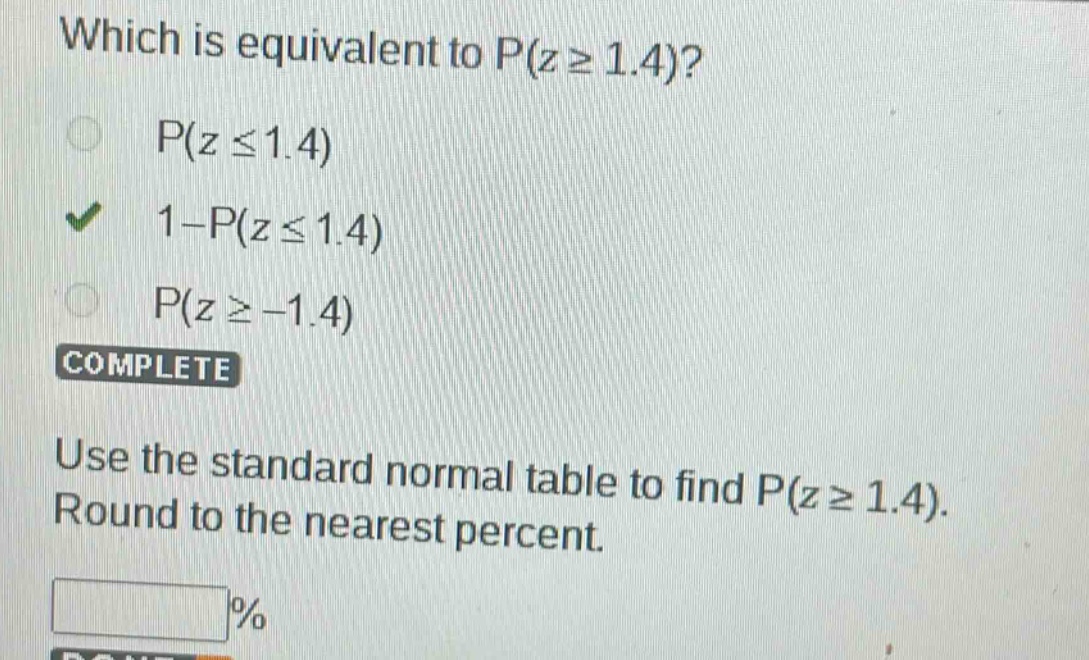
which is equivalent to p(z ≥ 1.4)?\np(z ≤ 1.4)\n1 - p(z ≤ 1.4)\np(z ≥ -1.4)\ncomplete\nuse the standard normal table to find p(z ≥ 1.4). round to the nearest percent.\n%
Answer
Explanation:
Step1: Recall normal - distribution property
The total area under the standard normal curve is 1. That is, (P(Z\lt+\infty)=1). Also, (P(Z\geq z)=1 - P(Z\lt z)) for any real - valued (z).
Step2: Use the standard normal table
Looking up (P(z\leq1.4)) in the standard normal table, we find that (P(z\leq1.4)=0.9192).
Step3: Calculate (P(z\geq1.4))
Since (P(z\geq1.4)=1 - P(z\leq1.4)), substituting the value of (P(z\leq1.4)) we get (P(z\geq1.4)=1 - 0.9192 = 0.0808).
Step4: Convert to percentage and round
To convert to a percentage, we multiply by 100: (0.0808\times100 = 8.08%). Rounding to the nearest percent gives (8%).
Answer:
(8%)