which is equivalent to p(z ≥ 1.4)?\np(z ≤ 1.4)\n1 - p(z ≤ 1.4)\np(z ≥ -1.4)\ndone
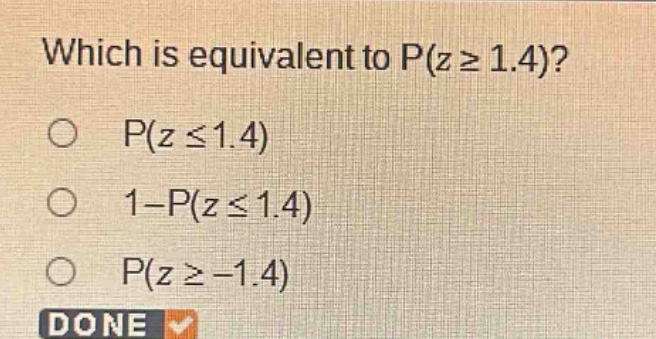
which is equivalent to p(z ≥ 1.4)?\np(z ≤ 1.4)\n1 - p(z ≤ 1.4)\np(z ≥ -1.4)\ndone
Answer
Explanation:
Step1: Recall normal - distribution property
The total area under the standard normal curve is 1. That is, for a standard normal random variable (z), (P(z<+\infty)=1). Also, (P(z\geq a)=1 - P(z < a)). When dealing with continuous random variables like the standard - normal variable (z), (P(z < a)=P(z\leq a)).
Step2: Apply the property to the given probability
We are given (P(z\geq1.4)). Using the property (P(z\geq a)=1 - P(z < a)), we can rewrite (P(z\geq1.4)) as (1 - P(z\leq1.4)) since for the continuous standard - normal distribution, (P(z < 1.4)=P(z\leq1.4)).
Answer:
(1 - P(z\leq1.4))