if events a and b are independent, and the probability that event a occurs is 83%, what must be true?\no the…
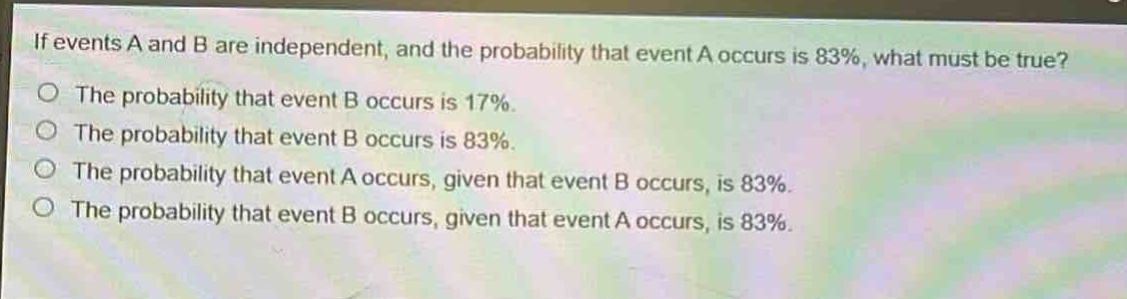
if events a and b are independent, and the probability that event a occurs is 83%, what must be true?\no the probability that event b occurs is 17%.\no the probability that event b occurs is 83%.\no the probability that event a occurs, given that event b occurs, is 83%.\no the probability that event b occurs, given that event a occurs, is 83%.
Answer
Answer:
C. The probability that event A occurs, given that event B occurs, is 83%.
Explanation:
Step1: Recall independence definition
If A and B are independent events, then $P(A|B)=P(A)$ and $P(B|A) = P(B)$.
Step2: Analyze given information
We know $P(A)=0.83$. Since A and B are independent, $P(A|B)=P(A) = 0.83$. That is, the probability that event A occurs, given that event B occurs, is 83%.
Step3: Analyze other options
Option A: There is no relation between $P(A)$ and $P(B)$ for independent events to make $P(B)=0.17$. Option B: There is no relation to make $P(B)=P(A)$. Option D: $P(B|A)=P(B)$ and there is no information to say $P(B)=0.83$.