if events a and b are independent, what must be true?\no p(a|b) = p(b)\no p(a|b) = p(a)\no p(a) = p(b)\no…
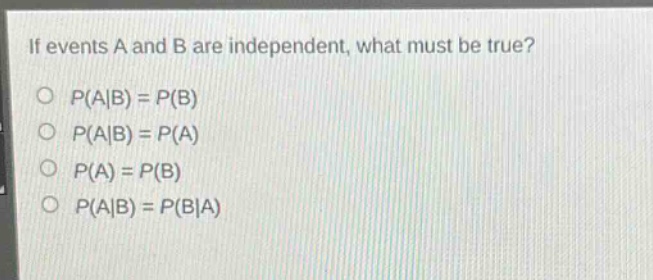
if events a and b are independent, what must be true?\no p(a|b) = p(b)\no p(a|b) = p(a)\no p(a) = p(b)\no p(a|b) = p(b|a)
Answer
Answer:
B. $P(A|B)=P(A)$
Explanation:
Step1: Recall definition of independence
If events $A$ and $B$ are independent, the occurrence of $B$ does not affect the probability of $A$.
Step2: Recall conditional - probability formula
The formula for conditional probability is $P(A|B)=\frac{P(A\cap B)}{P(B)}$.
Step3: Use independence property
For independent events $A$ and $B$, $P(A\cap B)=P(A)\times P(B)$.
Step4: Substitute into conditional - probability formula
Substituting $P(A\cap B)=P(A)\times P(B)$ into $P(A|B)=\frac{P(A\cap B)}{P(B)}$, we get $P(A|B)=\frac{P(A)\times P(B)}{P(B)} = P(A)$.