if events x and y are independent, what must be true? check all that apply.\n□ p(y | x)=0\n□ p(x | y)=0\n□…
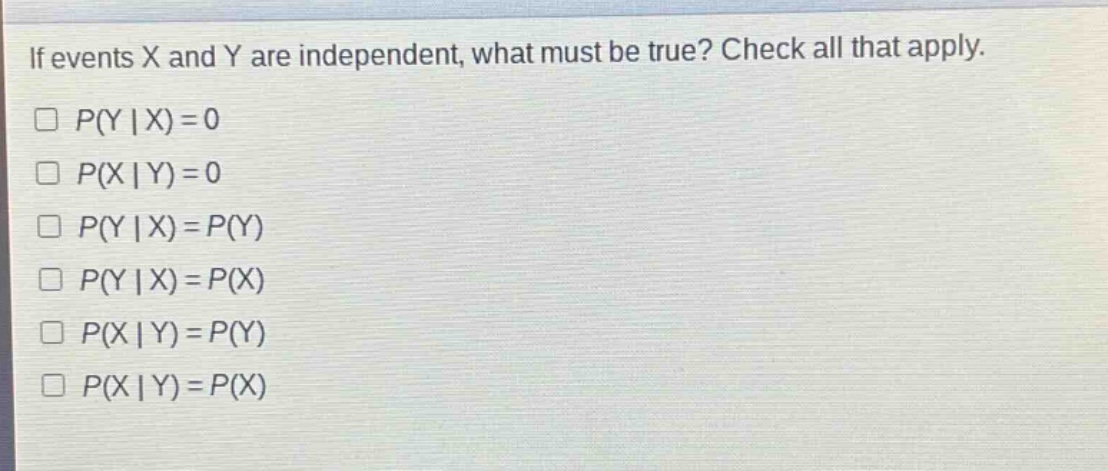
if events x and y are independent, what must be true? check all that apply.\n□ p(y | x)=0\n□ p(x | y)=0\n□ p(y | x)=p(y)\n□ p(y | x)=p(x)\n□ p(x | y)=p(y)\n□ p(x | y)=p(x)
Answer
Explanation:
Step1: Recall definition of independent events
If events $X$ and $Y$ are independent, the occurrence of $X$ does not affect the probability of $Y$ and vice - versa. The formula for conditional probability is $P(A|B)=\frac{P(A\cap B)}{P(B)}$ (when $P(B)\neq0$), and for independent events $P(A\cap B)=P(A)\times P(B)$.
Step2: Calculate $P(Y|X)$
$P(Y|X)=\frac{P(Y\cap X)}{P(X)}$. Since $X$ and $Y$ are independent, $P(Y\cap X) = P(Y)\times P(X)$. So $P(Y|X)=\frac{P(Y)\times P(X)}{P(X)}=P(Y)$ (when $P(X)\neq0$).
Step3: Calculate $P(X|Y)$
$P(X|Y)=\frac{P(X\cap Y)}{P(Y)}$. Since $X$ and $Y$ are independent, $P(X\cap Y)=P(X)\times P(Y)$. So $P(X|Y)=\frac{P(X)\times P(Y)}{P(Y)}=P(X)$ (when $P(Y)\neq0$).
Answer:
$P(Y|X)=P(Y)$, $P(X|Y)=P(X)$