the experiment involved tossing three coins simultaneously. the experiment was carried out 100 times, and it…
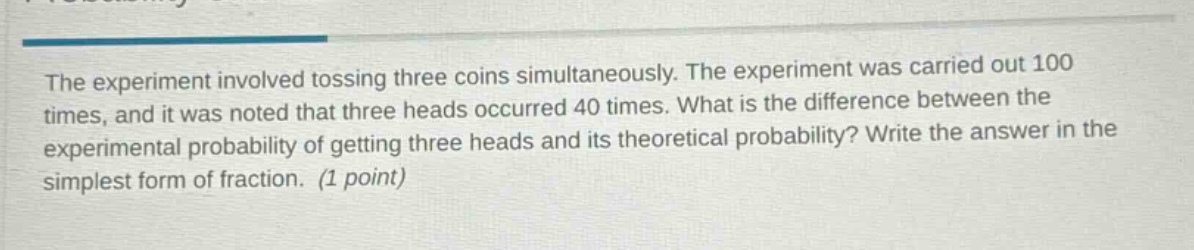
the experiment involved tossing three coins simultaneously. the experiment was carried out 100 times, and it was noted that three heads occurred 40 times. what is the difference between the experimental probability of getting three heads and its theoretical probability? write the answer in the simplest form of fraction. (1 point)
Answer
Explanation:
Step1: Calculate experimental probability
The experimental probability $P_{e}$ of an event is the number of times the event occurs divided by the total number of trials. Here, the number of times three - heads occurred is $n = 40$ and the total number of trials $N=100$. So, $P_{e}=\frac{40}{100}=\frac{2}{5}$.
Step2: Calculate theoretical probability
When tossing three coins simultaneously, the total number of possible outcomes is $2\times2\times2 = 8$ (since each coin has 2 possible outcomes: heads or tails). The event of getting three heads is just 1 outcome. So the theoretical probability $P_{t}=\frac{1}{8}$.
Step3: Calculate the difference
The difference $D$ between the experimental and theoretical probabilities is $D = P_{e}-P_{t}$. Substitute $P_{e}=\frac{2}{5}$ and $P_{t}=\frac{1}{8}$ into the formula: $D=\frac{2}{5}-\frac{1}{8}=\frac{2\times8 - 1\times5}{40}=\frac{16 - 5}{40}=\frac{11}{40}$.
Answer:
$\frac{11}{40}$