experiment\na litter of puppies consists of black puppies and white puppies. a puppy is randomly selected…
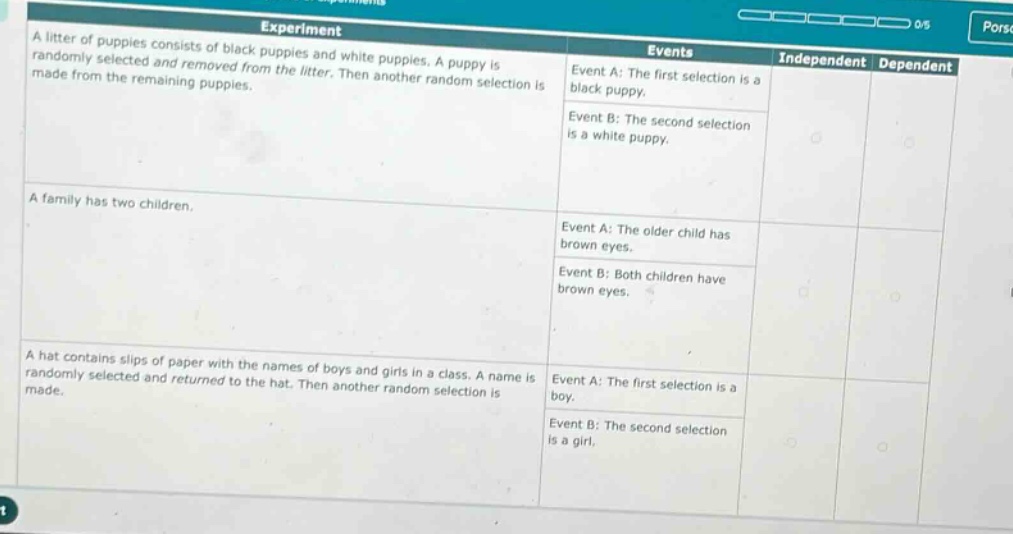
experiment\na litter of puppies consists of black puppies and white puppies. a puppy is randomly selected and removed from the litter. then another random selection is made from the remaining puppies.\na family has two children.\na hat contains slips of paper with the names of boys and girls in a class. a name is randomly selected and returned to the hat. then another random selection is made.\nevents\nevent a: the first selection is a black puppy.\nevent b: the second selection is a white puppy.\nevent a: the older child has brown eyes.\nevent b: both children have brown eyes.\nevent a: the first selection is a boy.\nevent b: the second selection is a girl.\nindependent dependent
Answer
Explanation:
Step1: Define independent and dependent events
Independent events: The occurrence of one event does not affect the probability of the other event. Dependent events: The occurrence of one event affects the probability of the other event.
Step2: Analyze the puppy - selection case
When a puppy is selected and removed from the litter, the composition of the remaining puppies changes. So, the probability of the second - selection (Event B) is affected by the first - selection (Event A). Thus, for the puppy selection: Event A: The first selection is a black puppy. Event B: The second selection is a white puppy. These are dependent events.
Step3: Analyze the family - children case
The eye - color of the older child does not determine the eye - color of the younger child. The probability that both children have brown eyes (Event B) is not affected by just the older child having brown eyes (Event A). So, these are independent events.
Step4: Analyze the hat - selection case
Since the name is returned to the hat after the first selection, the probability of the second selection (Event B) is not affected by the first selection (Event A). So, these are independent events.
Answer:
- Dependent
- Independent
- Independent