during an experiment natalie will spin the 2 fair spinners below. which answer represents the sample space…
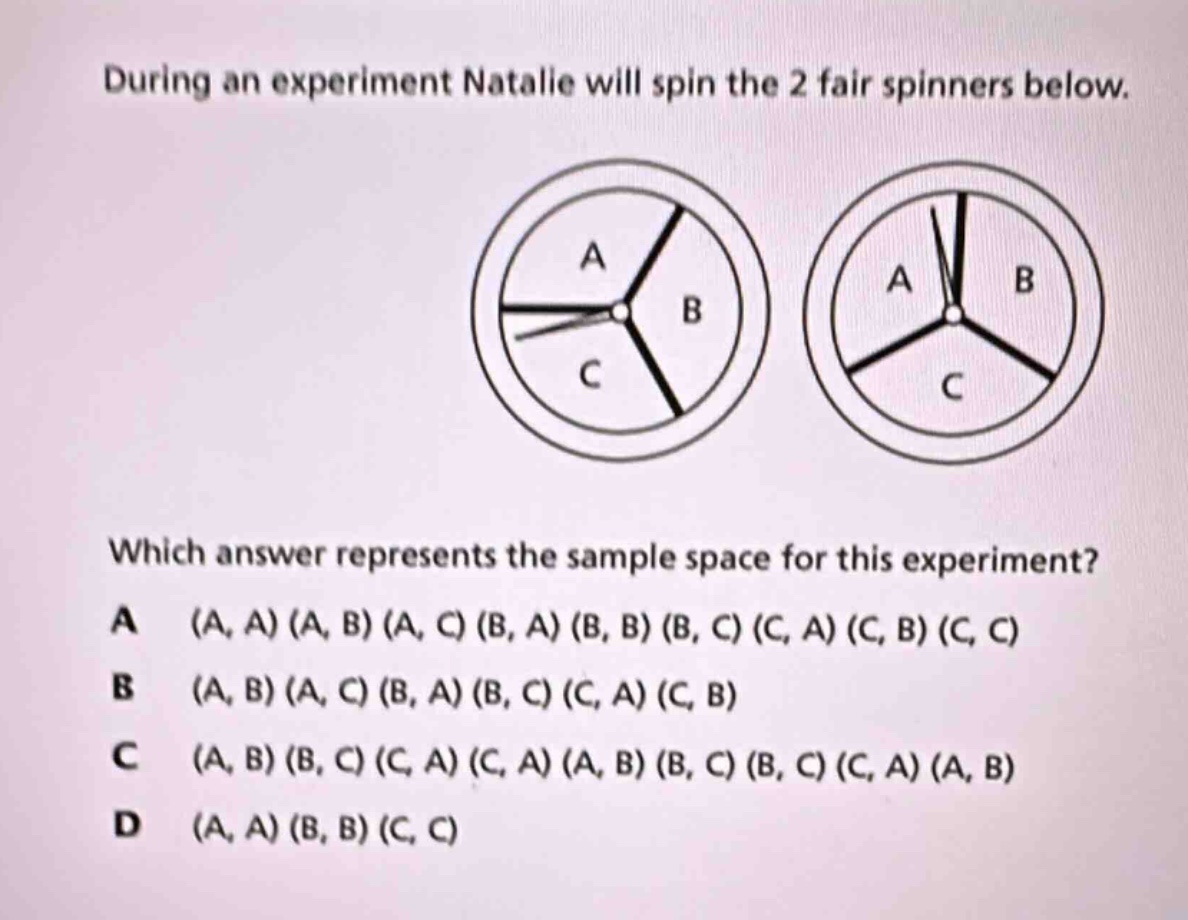
during an experiment natalie will spin the 2 fair spinners below. which answer represents the sample space for this experiment? a (a, a) (a, b) (a, c) (b, a) (b, b) (b, c) (c, a) (c, b) (c, c) b (a, b) (a, c) (b, a) (b, c) (c, a) (c, b) c (a, b) (b, c) (c, a) (c, a) (a, b) (b, c) (b, c) (c, a) (a, b) d (a, a) (b, b) (c, c)
Answer
Explanation:
Step1: Determine sample - space concept
The sample space is the set of all possible outcomes. When spinning two spinners each with 3 outcomes (A, B, C), we use the multiplication principle.
Step2: List all possible pairs
For the first spinner outcome A, the second spinner can be A, B, or C giving (A, A), (A, B), (A, C). For the first spinner outcome B, the second spinner can be A, B, or C giving (B, A), (B, B), (B, C). For the first spinner outcome C, the second spinner can be A, B, or C giving (C, A), (C, B), (C, C).
Answer:
A. (A, A) (A, B) (A, C) (B, A) (B, B) (B, C) (C, A) (C, B) (C, C)