explain why p(a|d) and p(d|a) from the table below are not equal.\n| | c | d | total |\n|----|----|----|----|…
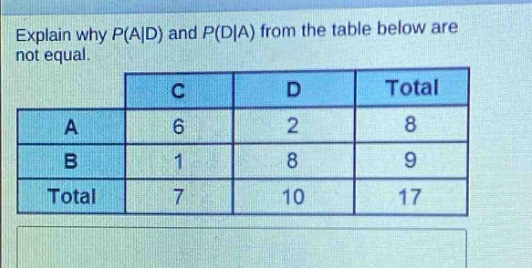
explain why p(a|d) and p(d|a) from the table below are not equal.\n| | c | d | total |\n|----|----|----|----|\n| a | 6 | 2 | 8 |\n| b | 1 | 8 | 9 |\n| total | 7 | 10 | 17 |
Answer
Explanation:
Step1: Recall conditional - probability formula
The formula for conditional probability is $P(A|B)=\frac{P(A\cap B)}{P(B)}$. So, $P(A|D)=\frac{P(A\cap D)}{P(D)}$ and $P(D|A)=\frac{P(A\cap D)}{P(A)}$.
Step2: Calculate $P(A\cap D)$
From the table, $P(A\cap D)=\frac{2}{17}$ since there are 2 elements in the intersection of A and D out of a total of 17 elements.
Step3: Calculate $P(D)$
$P(D)=\frac{10}{17}$ as there are 10 elements in D out of 17 total elements. Then $P(A|D)=\frac{P(A\cap D)}{P(D)}=\frac{\frac{2}{17}}{\frac{10}{17}}=\frac{2}{10}=\frac{1}{5}$.
Step4: Calculate $P(A)$
$P(A)=\frac{8}{17}$ as there are 8 elements in A out of 17 total elements. Then $P(D|A)=\frac{P(A\cap D)}{P(A)}=\frac{\frac{2}{17}}{\frac{8}{17}}=\frac{2}{8}=\frac{1}{4}$.
Answer:
Since $P(A|D)=\frac{1}{5}$ and $P(D|A)=\frac{1}{4}$, $P(A|D)$ and $P(D|A)$ are not equal because the denominators in their conditional - probability calculations (i.e., $P(D)$ and $P(A)$) are different, which changes the value of the fractions even though the numerator ($P(A\cap D)$) is the same for both.