a fair coin is flipped 10 times. it lands facing heads up 2 out of 10 times. the probability of a coin…
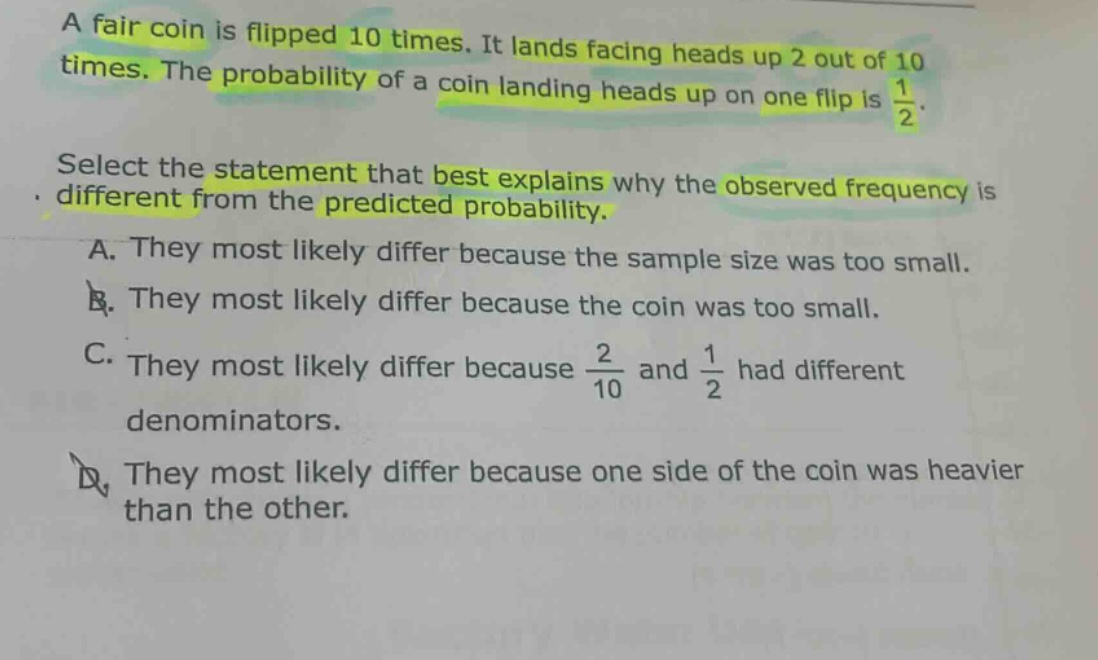
a fair coin is flipped 10 times. it lands facing heads up 2 out of 10 times. the probability of a coin landing heads up on one flip is $\frac{1}{2}$. select the statement that best explains why the observed frequency is different from the predicted probability. a. they most likely differ because the sample size was too small. b. they most likely differ because the coin was too small. c. they most likely differ because $\frac{2}{10}$ and $\frac{1}{2}$ had different denominators. d. they most likely differ because one side of the coin was heavier than the other.
Answer
Brief Explanations:
In probability, a small - sample size can lead to differences between observed frequencies and predicted probabilities. A fair coin has a 1/2 probability of landing heads up in a single flip. When flipped only 10 times, the sample is small, and random fluctuations can cause the observed frequency (2/10) to deviate from the theoretical probability. The size of the coin or the denominators are not relevant factors, and since it's a fair coin, one side is not heavier than the other.
Answer:
A. They most likely differ because the sample size was too small.